player background
live avator

5s
Total
0
Today
0
Total
0
Today
0
  • What would you like to know?
    Company Advantages Sample Service Certificates Logistics Service
Online Chat WhatsApp Inquiry
Auto
resolution switching...
Submission successful!

products details

Created with Pixso. Home Created with Pixso. Products Created with Pixso.
WPC Deck Flooring
Created with Pixso.

WPC 4 Hole Dual-Face Outdoor Decking 146x24mm Reversible Anti-Slip Wood Plastic Composite Deck Board

WPC 4 Hole Dual-Face Outdoor Decking 146x24mm Reversible Anti-Slip Wood Plastic Composite Deck Board

Brand Name: SUNHOUSE
Model Number: wpc-d-15
MOQ: 100㎡
Payment Terms: T/T
Detail Information
Place of Origin:
Foshan,Guangdong,China
Certification:
CE, FCC, REACH, and ISO 14001
Product Category:
WPC Deck Flooring
Advantage:
No Fading Color
Thickness:
Above 18mm
Slip-Resistant Texture:
Engineered Ribbed Surface Provides Traction In Wet Conditions (R10 Anti-slip Standard)
Eco-Friendly:
Made From 100% Recyclable Materials, Free From Formaldehyde And Heavy Metals
Applications:
Swimming Pool Surrounds, Garden Pathways, Marinas & Dock Boards
Surface Treatment:
Sanding, Embossing, Wood Grain
Name:
WPC Deck Flooring
Product Description

WPC 4 Hole Dual-Face Outdoor Decking 146x24mm Reversible Anti-Slip Wood Plastic Composite Deck Board


Product Overview of WPC Outdoor Decking

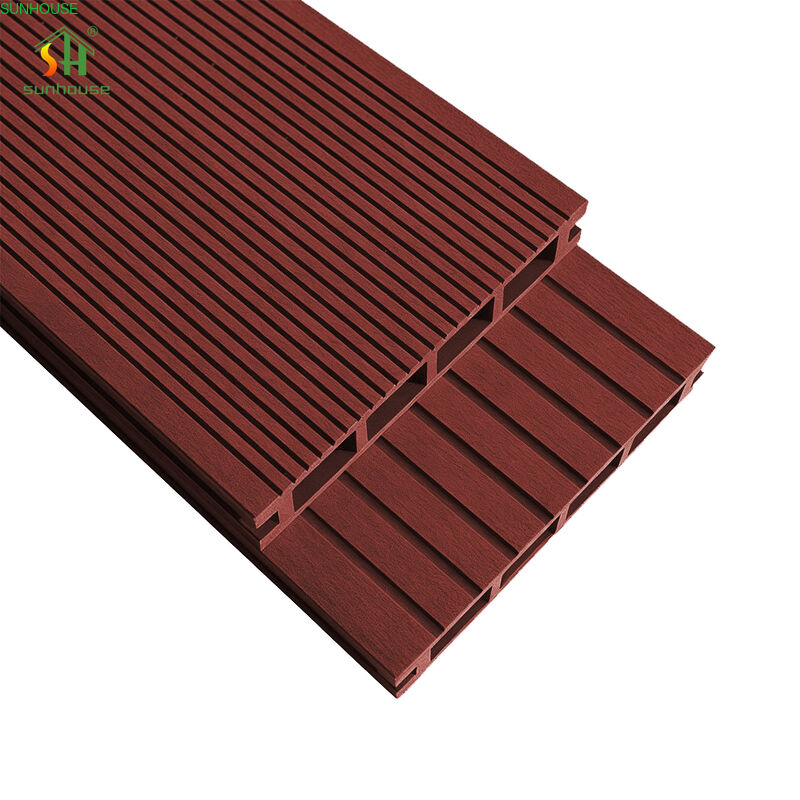
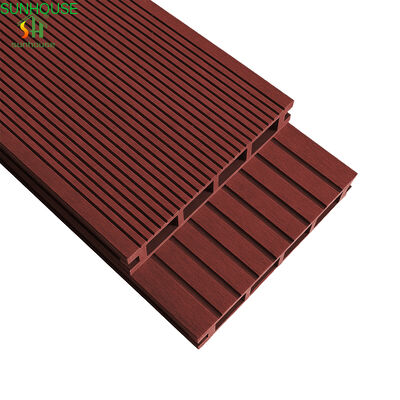
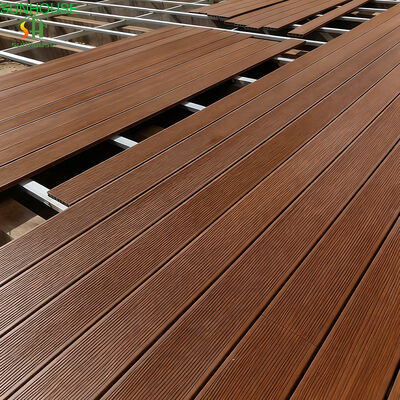
This 146x24mm four-chamber hollow WPC decking board introduces a reversible dual-face design that sets it apart from conventional single-face outdoor decking. Both faces of the board carry a fully finished 3D embossed texture, meaning the board can be flipped and reinstalled when the primary surface shows wear — effectively extending the functional service life without replacing the decking material. For property managers, resort operators, and contractors running high-traffic outdoor spaces, this translates directly into lower long-term flooring replacement cost per square metre.

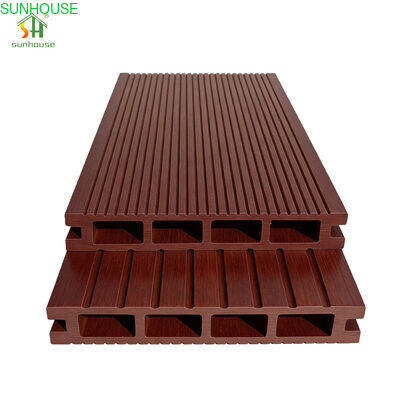
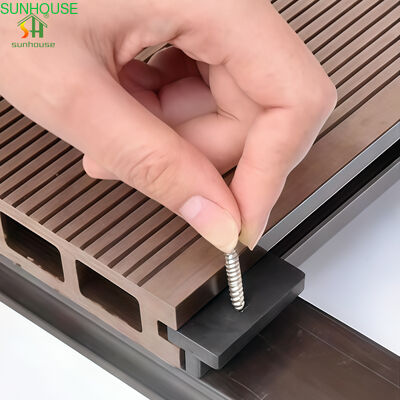
The four-hole hollow chamber profile is engineered to balance structural rigidity with reduced material weight. Four parallel internal voids run the full board length, cutting board mass relative to equivalent solid profiles while the remaining wall and rib structure maintains the load distribution required across a standard 400mm joist span. The result is a board that is easier to handle on site, less demanding on elevated subframes, and more cost-efficient to ship in volume — without compromising the surface performance expected of commercial-grade outdoor decking.

Surface texture is applied through a three-stage finishing process combining 3D embossing, sanding, and brushing. This layered approach produces a surface that reads as natural timber both visually and underfoot, with sufficient micro-texture to maintain grip in wet conditions. HDPE resin and UV stabilizer additives are compounded into the board body before extrusion — weatherproofing and color stability are built into the material structure, not dependent on surface treatments that degrade over time.


Product Features of WPC Outdoor Decking

  • Dual-Face Reversible Design — Extended Service Life: Both board faces carry identical 3D embossed texture. When the installed face shows surface wear, the board is lifted, flipped, and refixed — restoring a fresh decking surface without purchasing replacement material. In high-footfall applications, this feature can double the effective service interval between full deck replacements.
  • Four-Chamber Hollow Profile — Optimized Weight-to-Strength Ratio: Four parallel internal chambers reduce board weight against the same 146x24mm cross-section in solid form. Lower dead load simplifies installation on roof terraces and elevated timber subframes, and reduces per-container freight cost on bulk export orders — a measurable logistics saving on large project volumes.
  • 3D Emboss + Sand + Brush Triple Surface Process: The three-stage surface treatment creates a layered texture depth that single-step embossing cannot achieve. The finished surface presents realistic grain relief, consistent anti-slip friction, and a tactile quality that holds up to close inspection in premium residential and hospitality contexts.
  • Color-Specific Sizing — Multi-SKU Flexibility: Each color variant is available in its own section dimension, allowing specifiers to match board width and thickness to project aesthetic and load requirements independently of color selection. Red at 137x23mm, Brown at 140x22mm, Dark Brown at 140x23mm, Light Grey at 140x25mm, and Black at 146x24mm — with additional sizes including 148x23mm and 150x25mm available on request.
  • HDPE Composite — Moisture and Biological Resistance: High-density polyethylene resin binds the wood flour content throughout the board, sealing it against water ingress, fungal colonization, and insect penetration at the material level. The board will not absorb standing water, swell at joints, or develop surface mold under prolonged wet-weather exposure.
  • UV Stabilizer Integrated at Extrusion: Color pigment and UV-blocking additive are compounded into the raw material mix before board formation. Fading and surface chalking are resisted across years of direct sun exposure — relevant for pool decks, south-facing terraces, and equatorial climates where UV intensity accelerates color degradation in unprotected materials.
  • No Maintenance Schedule Required: The board surface does not require periodic oiling, sealing, sanding, or chemical treatment. Cleaning is limited to water rinse and mild detergent as needed — eliminating the recurring annual maintenance labor cost that makes natural timber decking expensive to operate over its lifecycle.
  • Custom Board Length: Length is cut to order at the production stage, allowing procurement teams to specify exact lengths for their project layout — reducing site offcut waste and avoiding the material loss that occurs when standard fixed-length boards are cut to fit non-standard deck dimensions.


Product Specifications of WPC Outdoor Decking

Parameter Specification Notes
Material HDPE + Wood Flour + Additives Wood Plastic Composite (WPC)
Profile Type 4-Hole Hollow Chamber Four parallel internal voids, dual-face finished
Standard Section Size 146 x 24mm (W x T) Black colorway standard size
Color-Specific Sizes Red: 137x23mm / Brown: 140x22mm / Dark Brown: 140x23mm / Light Grey: 140x25mm / Black: 146x24mm Also available: 148x23mm, 150x25mm
Length Customizable Cut to project-specified length on order
Surface Treatment 3D Embossed + Sanded + Brushed Three-stage process; both faces finished
Dual-Face Design Yes — Both Faces Textured Board reversible; extends usable service life
Standard Colors Coffee / Light Grey / Red / Dark Brown / Black / Teak Multiple wood grain tones available
Max Joist Spacing (C/C) 400mm Do not exceed 400mm centre-to-centre
Min. Ground Clearance (with drainage) 40mm Minimum recommended installation height
Min. Ground Clearance (without drainage) 90mm Required for enclosed or restricted sub-deck areas
Waterproof Yes — Full Board Profile HDPE matrix, non-porous throughout
Anti-Slip Yes — Both Faces 3D emboss texture provides wet-surface grip
UV Resistance Yes — Compound Integrated UV stabilizer added at raw material stage
Rot / Insect Resistance Yes HDPE encapsulation prevents biological access
Maintenance Water and mild detergent only No sealing, oiling, or chemical treatment needed
MOQ 100 m² Mixed color and size orders accepted
Origin Foshan, Guangdong, China Factory direct — no intermediary


Product Applications of WPC Outdoor Decking

The four-chamber dual-face WPC board addresses project scenarios where longevity, installation flexibility, and cost-per-year-of-use are evaluated alongside upfront material price. Its reversible face design and lightweight hollow profile make it particularly suited to applications where periodic surface renewal would otherwise require full material replacement.

  • Beachfront and Coastal Resort Decking: Salt air, sand abrasion, and high UV intensity accelerate surface wear on conventional decking materials. The dual-face board allows resort maintenance teams to flip worn boards during off-season refurbishment rather than replacing them — cutting material procurement cost on large poolside and beachfront deck areas without full closure for replacement works.
  • Rooftop Amenity Decks — Residential and Commercial: The four-hole hollow profile reduces structural dead load on the building slab compared to solid or composite tile alternatives. Lightweight boards are also easier to lift for periodic inspection of the waterproofing membrane beneath — a maintenance access advantage on rooftop installations.
  • Rental Villas and Short-Term Accommodation: High guest turnover produces concentrated surface wear on terrace and balcony decking. The reversible board face means a fresh surface can be presented between tenancy seasons without the cost or disruption of full deck replacement — directly improving the property's visual presentation and review scores.
  • School and Community Outdoor Play Areas: Wet-surface grip from the 3D embossed texture on both faces reduces slip risk in children's outdoor environments. The absence of chemical preservative treatments satisfies the material safety requirements common in institutional procurement specifications for educational facilities.
  • Covered Walkways and Transitional Outdoor Spaces: In partially sheltered environments — covered corridors, canopy-shaded paths, and building entry terraces — UV-stable color and moisture resistance are equally important. The brushed surface finish reduces glare under artificial lighting and maintains a professional appearance in high-visibility commercial circulation areas.
  • Landscape Staircases and Elevated Walkways: The anti-slip 3D embossed surface on both faces provides consistent grip on stepped and inclined installations where traction is a safety-critical design requirement. Custom-length production minimizes step-nosing offcut waste on staircase layouts with non-standard tread depths.
  • Agricultural and Industrial Outdoor Platforms: In environments where decking boards are subject to chemical splash, fertilizer contact, or heavy equipment rolling loads, the HDPE composite matrix resists surface degradation that would compromise timber or lower-grade composite boards. The hollow chamber profile keeps board weight manageable for manual handling on remote or access-restricted sites.


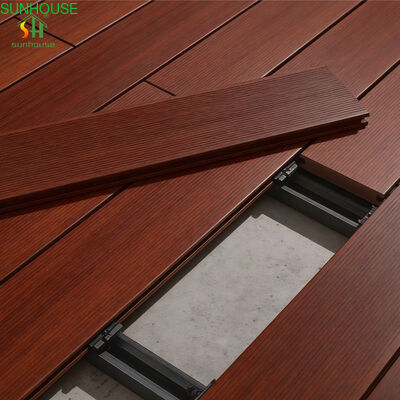
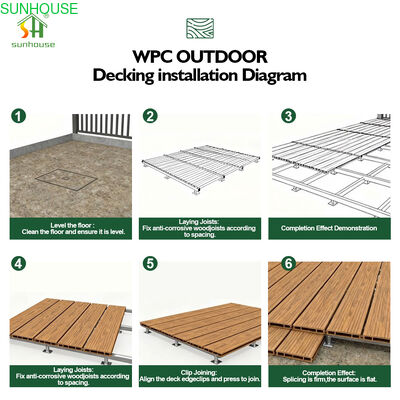
Installation Note: Maximum joist centre-to-centre spacing is 400mm. Maintain a minimum ground clearance of 40mm where sub-deck drainage is in place. In enclosed or poorly ventilated sub-deck conditions, increase clearance to a minimum of 90mm to ensure airflow through the hollow chamber voids and prevent moisture accumulation at the underside of the board.