
5s
+1
Submission successful!
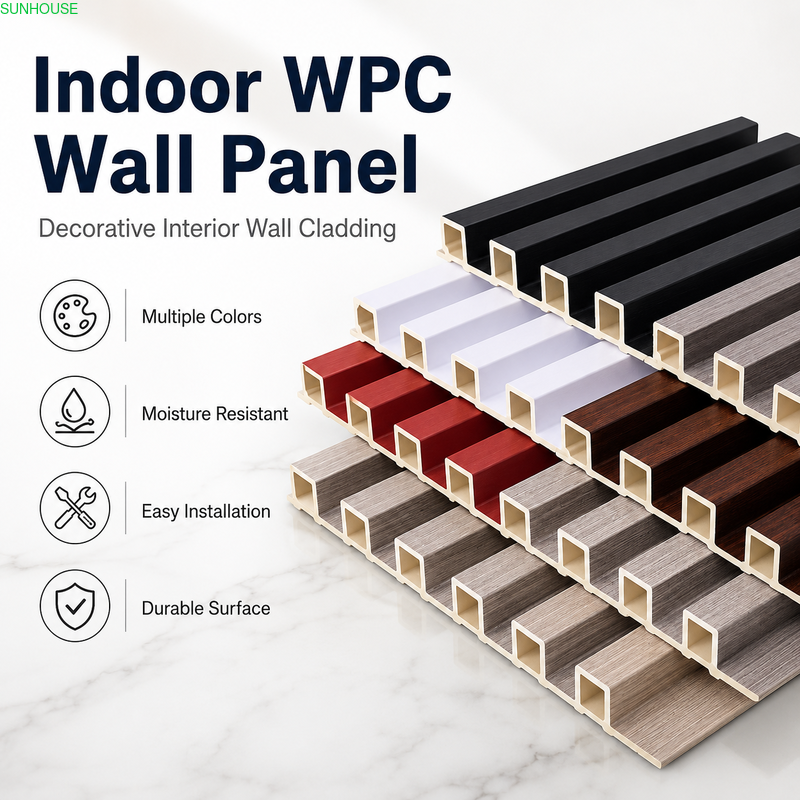
|
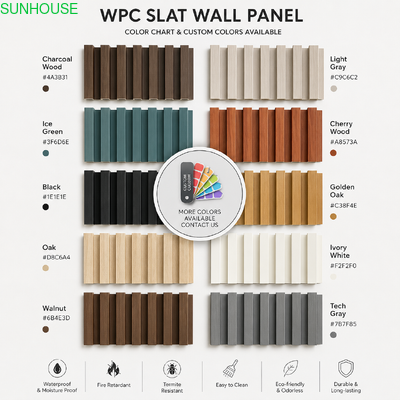
| Brand Name: | SUNHOUSE |
| Model Number: | WPC-08 |
| MOQ: | 200㎡ |
| Payment Terms: | T/T |
Fire rating, VOC emissions and compliance documentation are important purchasing considerations for WPC interior wall panels used in hotels, apartments, offices, retail stores, schools and other commercial interiors. However, the required standards can vary according to the destination market, building type, installation system and project specification.
Buyers should not simply ask whether a product is “certified.” A reliable assessment should confirm the applicable standard, tested product description, installation method, laboratory information, test result and validity of the supporting documents.
There is no single certification package suitable for every WPC interior wall panel order. Before requesting documents from a supplier, buyers should identify where and how the product will be used.
National regulations and accepted test standards can differ. The importer should confirm the applicable local requirements before production.
Hotels, hospitals, schools, public buildings and transportation facilities may have stricter requirements than private residential interiors.
Requirements may differ for corridors, escape routes, bedrooms, reception areas, ceilings, feature walls and concealed installations.
Adhesive, battens, metal framing, substrate type, air gaps and joint details may influence the fire performance of the completed assembly.
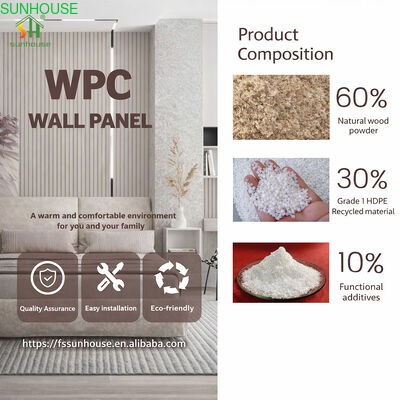
WPC wall panels normally contain polymer resin, wood powder, mineral filler, pigments and additives. Their fire performance can change when the material formula, wall thickness, hollow-core structure, surface film or flame-retardant additive system changes.
A product described as fire retardant is not necessarily non-combustible. Buyers should review the actual classification and test results instead of relying on general terms such as fireproof, flameproof or self-extinguishing.
| Term | What Buyers Should Understand | Recommended Verification |
|---|---|---|
| Fire Retardant | The product is formulated to improve certain fire-performance characteristics | Request the complete test report and classification |
| Flame Spread | Describes how flame travels across the tested surface under specified conditions | Check the test method, result and classification criteria |
| Smoke Production | Indicates the amount or rate of smoke produced during the specified test | Confirm whether smoke performance is included in the report |
| Burning Droplets | Relates to flaming particles or droplets generated during testing | Check whether the selected standard includes this classification |
| Non-Combustible | A specific technical classification that should not be used without supporting test evidence | Do not accept marketing descriptions as proof |
The applicable test method should be confirmed by the project consultant or importing party. Depending on the destination and application, buyers may encounter standards related to reaction to fire, surface burning characteristics, flame spread, smoke development or building material classification.
| Market Or Requirement | Commonly Discussed Test Direction | Buyer Action |
|---|---|---|
| European Projects | Reaction-to-fire testing and classification under the applicable European system | Confirm the exact classification required by the project specification |
| United States Projects | Surface burning characteristics, flame spread and smoke development | Confirm the required method with the local code consultant or importer |
| United Kingdom Projects | Project-specific reaction-to-fire or surface-spread requirements | Confirm current local requirements and accepted supporting documentation |
| China-Based Testing | Building material combustion performance classification | Confirm whether the destination market accepts the report |
| Hotel Or Public Project | Specified fire, smoke and installation-system requirements | Follow the tender document rather than a general supplier recommendation |
The test report should clearly identify the standard edition, test procedure and classification rules. A document that only shows a grade without describing the test method may be insufficient for project approval.
A valid-looking fire report may still be unsuitable if the tested sample differs from the product being purchased. Changes in thickness, density, material formula, profile structure or surface covering can influence performance.
A supplier may provide a fire report for a solid, uncoated WPC profile while the actual order uses a hollow profile with a laminated decorative film. Even when both products are called WPC wall panels, the report may not represent the ordered product.
Buyers do not need to be laboratory specialists, but several basic sections should be checked before accepting a report.
| Report Section | What To Check | Common Risk |
|---|---|---|
| Applicant | Company name and relationship to the supplier | The report may belong to an unrelated manufacturer |
| Sample Description | Material, dimensions, profile, finish and product model | The description may be too general to match the order |
| Test Standard | Full standard number, edition and test method | The project may require a different standard |
| Mounting Method | Substrate, adhesive, air gap, frame and orientation | The test configuration may differ from site installation |
| Test Results | Measured values and classification | A cover page may hide failed or limited results |
| Laboratory | Laboratory name, address, accreditation and authorized signature | The issuing organization may not be qualified for the test |
| Report Number And Date | Unique report identification and test date | The document may be altered, incomplete or outdated |
VOC testing is often requested for interior products because decorative panels are installed over large wall areas in occupied spaces. However, the term low VOC is incomplete unless the test method, chamber conditions, measured substances, units and acceptance criteria are identified.
Depending on the destination market or project specification, buyers may be asked to evaluate total volatile organic compounds, individual VOC substances, formaldehyde, odor or other indoor air quality indicators.
Total volatile organic compounds represent a combined measurement under the specified test method. Buyers should check the test period and result unit.
Confirm whether formaldehyde was included, the method used and whether the requirement applies to the WPC panel itself or to another component.
Some projects evaluate specific compounds separately rather than accepting only one total VOC value.
A strong odor is not a substitute for laboratory testing, but it can indicate unstable raw materials, packaging contamination or incomplete production control.
VOC emissions can be influenced by more than the WPC core. Decorative films, printing inks, adhesives, protective coatings, packaging and production conditions may also affect the final tested result.
CE marking should only be used when the product is covered by applicable European requirements that provide a legal route for CE marking. It is not a universal quality certificate and should not be treated as a general laboratory approval.
Before requesting CE documentation for a WPC interior wall panel, buyers should determine whether the specific product and intended use are covered by an applicable harmonised technical route.
| Document Or Item | What Buyers Should Verify |
|---|---|
| Applicable Product Standard | Confirm that the technical standard or assessment route covers the actual product |
| Declared Intended Use | Check whether the declared application matches interior wall installation |
| Declaration Of Performance Or Conformity | Confirm the correct document type required by the applicable legislation |
| Declared Performance | Review the characteristics and values declared for the product |
| Technical Documentation | Ensure reports, production controls and supporting evidence are available |
| Manufacturer Information | Check the legal manufacturer name, address and product identification |
REACH addresses chemical substances and related obligations in the European market. For WPC wall panels, buyers commonly focus on restricted substances, substances of very high concern and chemical content in the core, decorative film, pigments, stabilizers and additives.
REACH compliance should not be evaluated only by checking whether a document contains a REACH logo. The buyer should understand what substances were assessed and which product components were covered.
RoHS is mainly associated with electrical and electronic equipment. A standard non-electrical WPC wall panel should not automatically be described as requiring RoHS certification.
RoHS may become relevant when the supplied system includes electrical or electronic components, such as integrated LED lighting, power supplies, controllers, wiring or electronic accessories. In that case, buyers should define which components are within the compliance scope.
| Product Configuration | Recommended Buyer Approach |
|---|---|
| Standard Non-Electrical WPC Panel | Prioritize applicable chemical, fire and indoor-emission requirements |
| WPC Panel With LED Strip | Separate the wall panel requirements from the electrical component requirements |
| Integrated Lighting System | Confirm compliance for power supplies, wiring, controllers and lighting components |
| Project Requests RoHS Testing | Clarify whether it is a contractual material test or a legally applicable requirement |
Buyers should distinguish a WPC wall panel from regulated composite wood panels such as MDF, particleboard or hardwood plywood. A pure extruded WPC profile should not automatically be described as TSCA Title VI certified.
Additional review may be necessary when a finished wall panel system contains MDF backing, particleboard, plywood or another regulated composite wood component.
Confirm the actual core composition and request appropriate emissions data without automatically applying a composite wood certification.
Identify the MDF manufacturer, certification status, labeling and supporting documentation for the regulated component.
Formaldehyde and VOC assessment may still be requested for the finished product even when a specific composite wood rule does not apply.
Check whether the supplied report covers the complete finished product or only one individual material layer.
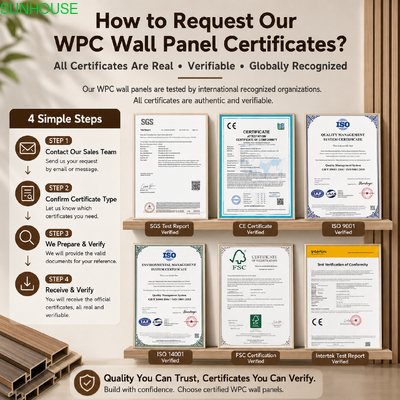
The required documentation package should be based on the destination market and project contract. Depending on the product and application, buyers may request some of the following documents.
A professional-looking report is not automatically authentic. Buyers should perform basic verification before using the document for tender submission, import clearance or project approval.
| Red Flag | Possible Risk | Buyer Response |
|---|---|---|
| Only The First Page Is Provided | Important results, limitations or failed items may be hidden | Request the complete report |
| Product Description Is Very General | The tested sample may not match the ordered panel | Request profile photographs and technical details |
| Supplier Calls Every Report A Certificate | The legal purpose and scope of the document may be misunderstood | Identify whether it is a test report, declaration or conformity document |
| Fire Grade Has No Test Standard | The classification cannot be evaluated | Request the complete test method and classification basis |
| Different Company Name | The report may belong to another factory | Request authorization and supply-chain evidence |
| Report Covers Another Thickness | The performance may not represent the ordered product | Ask for technical confirmation or additional testing |
| No Installation Details | The site system may differ from the tested assembly | Confirm mounting, substrate and air-gap conditions |
Fire rating and emissions requirements should be included in the purchase order, contract or approved technical specification. Verbal promises are difficult to enforce during production and inspection.
No. Fire retardant normally describes improved performance under a specified test. Buyers should review the actual classification rather than interpreting it as non-combustible.
Not automatically. Thickness, profile structure, density, surface film, formula and installation conditions may affect whether the report represents another product.
No. CE marking depends on whether the specific product and intended use fall under an applicable European regulatory and technical route.
REACH is related to chemical substance compliance. Buyers should review declarations, substance scope and supporting test evidence rather than relying only on a document title.
A non-electrical wall panel should not automatically be treated as an electrical or electronic product. Applicability should be reviewed when LED lighting or electrical components are included.
No. Buyers should identify the actual regulated material category. A WPC profile and an MDF panel are different product structures and should not be treated as automatically equivalent.
No. Request the complete document, check the tested product and verify the issuing laboratory before using it for project or import approval.
We supply WPC fluted interior wall panels for distributors, contractors, wholesalers and commercial projects. Product specifications, available test reports, installation information, color samples and supporting technical documents can be provided according to the selected product configuration.
Send us your destination market, project type, required fire classification, VOC requirement, panel profile, color and order quantity for document review, sample evaluation and wholesale pricing.


 english
 français
 Deutsch
 Italiano
 Русский
 Español
 português
 Nederlandse
 ελληνικά
 日本語
日本語
 한국
한국
 العربية
 हिन्दी
 Türkçe
 indonesia
 tiếng Việt
 ไทย
ไทย
 বাংলা
বাংলা
 فارسی
فارسی
 polski
