


 english
 français
 Deutsch
 Italiano
 Русский
 Español
 português
 Nederlandse
 ελληνικά
 日本語
日本語
 한국
한국
 العربية
 हिन्दी
 Türkçe
 indonesia
 tiếng Việt
 ไทย
ไทย
 বাংলা
বাংলা
 فارسی
فارسی
 polski
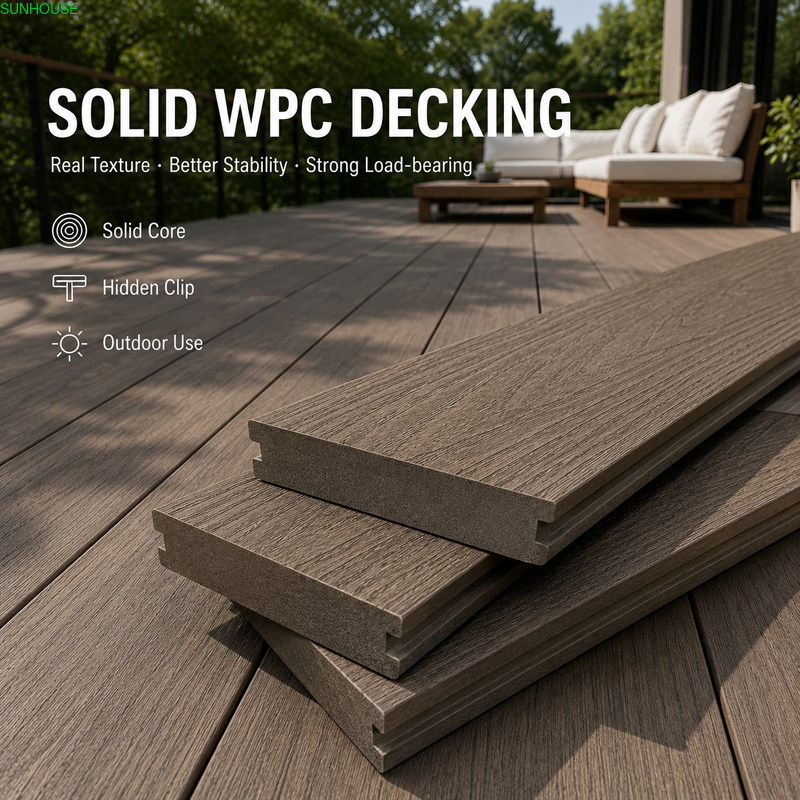
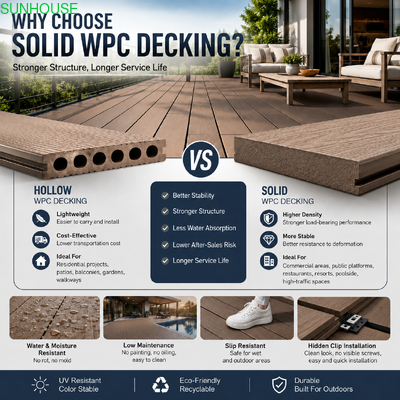
How To Evaluate Solid WPC Outdoor Decking Quality Before Bulk Purchasing
Solid WPC outdoor decking from different suppliers may have similar colors, wood grain patterns and dimensions, but the internal material formula, density, structural consistency, surface protection and long-term outdoor performance can vary significantly.
For importers, distributors, contractors and project buyers, quality evaluation should focus on raw material control, profile structure, weight consistency, bending performance, impact resistance, weather stability, co-extrusion quality and installation compatibility rather than comparing price or product weight alone.
In this guide, solid WPC decking refers to a solid-profile wood plastic composite decking board. It does not mean natural solid timber decking.
1. Understand What Solid WPC Decking Is
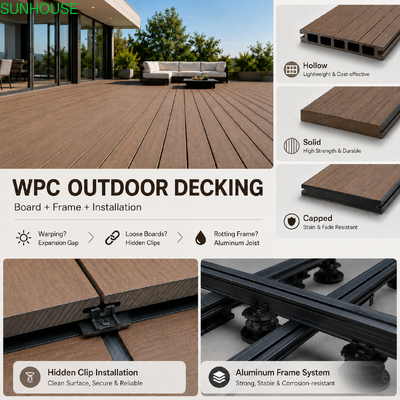
Solid WPC decking is manufactured from a mixture of thermoplastic resin, wood fiber or wood powder, mineral filler, pigments, stabilizers, lubricants and other functional additives. Unlike hollow decking, the profile does not contain large designed internal chambers.
The solid structure usually increases material consumption and product weight. It may provide useful advantages for certain projects, but solid construction alone does not guarantee higher quality.
| Solid Profile Characteristic | Possible Advantage | Buyer Consideration |
|---|---|---|
| Higher Material Volume | May provide a more substantial profile and improved local impact resistance | Higher material volume also increases weight, price and freight cost |
| No Large Hollow Chambers | Cut ends do not expose large internal cavities | Small internal pores or extrusion defects may still be present |
| Greater Unit Weight | Can feel more substantial during handling | Weight must be compared with strength, filler content and structural consistency |
| Solid Edge Area | May provide more flexibility for some cutting and fixing details | Fastener positions and edge distances must still follow the installation instructions |
2. Check The Raw Material Composition
The raw material formula is one of the most important factors affecting solid WPC decking quality. Products with similar weight and dimensions may use very different resin, wood powder, filler and additive systems.
1Polymer Resin
The polymer component contributes to moisture resistance, toughness and process stability. Buyers should confirm the general resin system and production consistency.
2Wood Fiber Or Powder
Wood material affects appearance, stiffness and processing. Moisture, particle size and contamination should be controlled before extrusion.
3Mineral Filler
Mineral filler can influence weight, hardness, dimensional behavior and production cost. Excessive filler may make the profile heavy but brittle.
4Functional Additives
Stabilizers, pigments, lubricants, coupling agents and UV-related additives help control processing and outdoor performance.
- Ask whether the product uses virgin, recycled or mixed polymer materials.
- Confirm how recycled materials are selected, cleaned and controlled.
- Check whether strong odor or visible contamination is present in cut samples.
- Compare the material formula used for samples with the formula intended for mass production.
- Request technical data or relevant test reports for the exact decking model being purchased.
3. Do Not Judge Quality By Weight Alone
Solid WPC decking is normally heavier than hollow decking of a similar size, but a heavier board is not necessarily a better board. Weight can increase because of greater profile dimensions, higher density or increased mineral filler content.
| Weight Observation | Possible Explanation | Additional Check Required |
|---|---|---|
| Higher Unit Weight | More material, larger dimensions or higher density | Check bending, impact resistance, filler content and freight effect |
| Lower Unit Weight | Lower density, smaller dimensions or process variation | Check profile size, internal porosity and strength |
| Large Weight Difference Between Boards | Unstable feeding, formula variation or dimensional inconsistency | Sample boards from different cartons and production times |
| Heavy But Brittle Board | Possible excessive mineral filler or unsuitable material balance | Conduct impact, cutting and bending comparisons |
4. Inspect The Solid Cross-Section
A clean and uniform cross-section is an important indicator of extrusion stability. Cut samples from several boards and inspect the complete profile rather than evaluating only the decorative surface.
- Look for large pores, air pockets, cracks and weak internal areas.
- Check for visible foreign particles, burnt material or inconsistent color inside the core.
- Compare the profile thickness across the full width.
- Inspect both ends and a middle section of the board where practical.
- Check whether edge grooves and clip channels are accurately formed.
- Compare samples from different production batches or cartons.
- Observe whether the cut edge chips excessively or breaks in large brittle pieces.
| Cross-Section Condition | Possible Meaning | Buyer Response |
|---|---|---|
| Uniform Fine Structure | May indicate stable mixing and extrusion | Compare with performance and batch consistency |
| Large Voids Or Pores | Possible moisture, gas release or unstable processing | Request production review and additional samples |
| Dark Burnt Particles | Possible overheated or degraded material | Check whether contamination appears throughout the batch |
| Uneven Density | Possible material feeding or cooling inconsistency | Compare board weight, dimensions and mechanical performance |
| Brittle Cut Edge | Possible formulation imbalance or excessive filler | Conduct cutting, drilling and impact comparisons |
5. Evaluate Density And Brittleness Together
Density is useful for quality control, but the highest possible density should not be treated as the purchasing target. A well-balanced product should provide suitable stiffness while maintaining enough toughness for transportation, cutting, drilling and outdoor service.
Very Low Density
May indicate excessive porosity, insufficient material or unstable extrusion. Structural performance should be checked carefully.
Very High Density
May increase weight and surface hardness but can also be associated with high mineral filler content and reduced toughness.
Balanced Density
Should be evaluated according to the specific product formula, dimensions and intended application, not one universal target.
Batch Density Control
Consistency between boards is often more important for bulk purchasing than one unusually high laboratory value.
6. Check Bending And Load Performance
Solid WPC decking should be evaluated for its intended support spacing and application. A board that feels rigid when held by hand may still deflect excessively when installed over an unsuitable joist spacing.
- Request bending or flexural test information for the actual product profile.
- Confirm the test span, loading method and sample dimensions.
- Compare the test configuration with the proposed joist spacing.
- Check both strength and deflection rather than looking only at the maximum load.
- Confirm whether the project includes concentrated loads, commercial traffic or heavy furniture.
- Do not assume that solid decking can be installed over any support spacing.
Why Test Conditions Matter
A load result cannot be evaluated without knowing the board profile, test span, support condition and loading method. The same decking board can show very different deflection when the distance between joists changes.
7. Test Impact Resistance And Edge Strength
Outdoor decking can be damaged during container loading, unloading, site handling and installation. Buyers should inspect whether the product is excessively brittle at the edges, corners and clip grooves.
| Inspection Area | What To Check | Possible Risk |
|---|---|---|
| Board Corners | Check whether light impact causes large chips or cracks | Transport and installation damage |
| Side Grooves | Inspect the hidden clip channel for cracking | Loose boards or failed hidden fastening |
| Cut Ends | Check whether sawing creates uncontrolled splitting | Poor finishing and material waste |
| Screw Areas | Test drilling and fastening according to the installation method | Cracks caused by incorrect pilot holes or fastener pressure |
| Cold-Condition Handling | Confirm project-specific performance where low-temperature installation is expected | Increased brittleness under unsuitable conditions |
8. Compare Traditional And Co-Extruded Solid WPC Decking
Solid WPC decking may be supplied as a traditional uncapped profile or with a co-extruded protective surface layer. Buyers should identify the exact structure because the appearance, stain behavior, weather exposure and inspection requirements are different.
| Comparison Point | Traditional WPC Surface | Co-Extruded WPC Surface |
|---|---|---|
| Surface Structure | Core material forms the visible surface | Additional protective surface layer covers selected faces |
| Wood Grain Appearance | Usually brushed, sanded or embossed directly on the profile | Can provide more controlled color and multi-tone effects |
| Main Inspection Focus | Core surface consistency, brushing and color variation | Cap-layer thickness, coverage, bonding and edge quality |
| Surface Damage | Damage exposes the same general core material | Deep damage may expose a visibly different core |
| Purchasing Comparison | Evaluate formula, surface treatment and weathering data | Evaluate both core quality and protective-layer performance |
9. Inspect The Co-Extrusion Protective Layer
When purchasing capped or co-extruded solid WPC decking, the surface layer should be inspected across the full profile and along the complete board length.
- Check whether the protective layer covers all surfaces promised in the quotation.
- Inspect the top surface, side edges, grooves and board ends.
- Compare the layer thickness at several cut positions.
- Look for separation, bubbles, missing areas and irregular color lines.
- Check whether bending or cutting causes the surface layer to separate from the core.
- Confirm the approved texture, color and gloss level.
- Review weathering, stain or adhesion data where required by the project.
10. Evaluate Surface Texture And Slip Considerations
Outdoor decking commonly uses brushed, grooved or embossed surfaces. The surface design affects appearance, cleaning, water movement and underfoot feel.
Brushed Surface
Can create a natural wood-like appearance. Buyers should inspect brushing depth, direction and consistency across the batch.
Embossed Wood Grain
Provides decorative texture but the grain repeat, depth and surface durability should be confirmed.
Grooved Surface
Can influence drainage and visual direction. Deep grooves may require additional cleaning.
Mixed Surface Design
Some boards provide different finishes on each face. Confirm which side is approved for installation.
Claims such as anti-slip or slip resistant should be supported by an identified test method and result where the project requires documented performance. Wet, dirty or algae-covered surfaces can behave differently from clean laboratory samples.
11. Check Color Consistency And Expected Weathering
Outdoor WPC decking can change appearance after exposure to sunlight and weather. Buyers should distinguish between initial batch color variation, normal early weathering and unacceptable production inconsistency.
| Color Issue | Possible Cause | Buyer Control Method |
|---|---|---|
| Different Colors Before Installation | Different pigment, raw material or production batches | Compare panels under the same lighting and separate different batches |
| Uneven Surface Tone | Extrusion, brushing, embossing or co-extrusion variation | Inspect multiple boards side by side |
| Early Outdoor Color Change | Surface exposure and material stabilization | Request supplier guidance and relevant weathering data |
| Different Weathering Between Areas | Unequal sunlight, shading, drainage or exposure | Set realistic project expectations and installation planning |
| Replacement Board Mismatch | Different production date or weathering history | Keep same-batch spare boards for future maintenance |
12. Review UV And Weathering Test Information
Outdoor decking is exposed to sunlight, moisture, heat, cold and repeated environmental changes. Weathering claims should be evaluated through identified test methods, exposure conditions and measured results rather than general statements such as no fading or permanent color.
- Confirm the exact product model, color and surface type used for testing.
- Check whether the report applies to capped or uncapped decking.
- Review exposure duration and test conditions.
- Check the measured color change, surface cracking or other reported properties.
- Confirm whether the supplier changed the formula after the test was completed.
- Ask whether darker and lighter colors have separate weathering information.
- Avoid comparing results from unrelated standards as directly equivalent.
13. Check Water Absorption And Moisture Stability
WPC decking is commonly selected for outdoor use because it does not behave like untreated natural timber. However, it should not be described as completely unaffected by water without supporting evidence.
Water absorption, thickness change and long-term moisture exposure can be influenced by the material formula, wood content, profile structure, surface protection and cut edges.
| Moisture Check | Buyer Question |
|---|---|
| Water Absorption | Which test method, exposure period and result apply to the exact product? |
| Thickness Change | Was dimensional change measured after moisture exposure? |
| Cut-End Exposure | Does the product require special treatment at cut ends? |
| Standing Water | What drainage and ventilation conditions are required? |
| Poolside Or Coastal Use | Are there project-specific recommendations for chemicals, salt or high humidity? |
14. Evaluate Thermal Expansion And Dimensional Stability
WPC decking can expand and contract as temperatures change. Solid profiles contain more material and may respond differently from hollow profiles depending on the formulation and dimensions.
- Request the supplier's installation guidance for side, end and perimeter gaps.
- Confirm whether gap recommendations change with board length and site temperature.
- Check the expected maximum and minimum installation temperatures.
- Do not force boards tightly between walls, columns or fixed boundaries.
- Confirm whether long deck areas require additional movement planning.
- Review the relationship between clip spacing, board movement and end joints.
- Verify whether expansion values are based on the exact profile being ordered.
15. Match Decking Quality With The Installation System
Even a well-manufactured solid WPC board can fail when installed over unsuitable joists, incorrect spacing, weak clips, poor drainage or unsupported board ends.
| Installation Component | Quality Point To Confirm | Possible Failure If Incorrect |
|---|---|---|
| Joists | Material, dimensions, support spacing and structural stability | Deck deflection, movement or uneven surface |
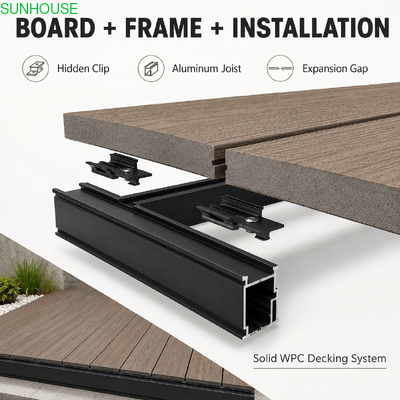
| Hidden Clips | Fit with the side groove, material quality and spacing control | Loose boards, damaged grooves or inconsistent gaps |
| Screws | Length, head design, corrosion resistance and substrate compatibility | Pull-out, corrosion or cracked fixing points |
| End Support | Proper support at board ends and butt joints | Loose ends, uneven joints or excessive movement |
| Drainage And Ventilation | Water escape, airflow and clearance beneath the deck | Standing water, contamination and maintenance problems |
16. Inspect Groove Accuracy And Clip Compatibility
Hidden clips usually engage with side grooves. If the groove is too narrow, too wide, brittle or uneven, installation may become difficult and spacing between boards may be inconsistent.
- Assemble several decking boards using the actual clips and screws.
- Check whether clips slide or fit into the grooves without excessive force.
- Inspect the groove edge after fastening for cracks or deformation.
- Measure the installed board gap at several positions.
- Confirm whether starter clips and finishing clips are required.
- Check whether clips are plastic, stainless steel or another specified material.
- Approve decking, clips and screws as one complete installation system.
17. Check Board Straightness And Dimensional Tolerances
Long solid WPC decking boards should be inspected for bowing, twisting, width variation and uneven thickness. Dimensional inconsistency can make installation slower and create irregular deck gaps.
| Dimension | Inspection Method | Installation Effect |
|---|---|---|
| Board Length | Measure boards from different cartons | Affects end alignment and cutting allowance |
| Board Width | Measure at the beginning, middle and end | Affects installed gaps and total coverage |
| Board Thickness | Check several points across the profile | Affects surface level and clip compatibility |
| Straightness | Place the board on a flat reference surface | Affects installation speed and deck alignment |
| Twist | Observe whether all corners rest evenly | Can create loose areas and uneven fastening |
18. Review Odor And Material Cleanliness
Strong or unusual odor can indicate unstable recycled materials, contamination, packaging issues or incomplete production control. Odor alone does not prove whether a product is compliant, but it is a useful preliminary inspection point.
- Open several cartons rather than checking one sample only.
- Inspect the core for foreign particles and inconsistent internal color.
- Compare odor between approved samples and production boards.
- Request relevant chemical or restricted-substance information for the destination market.
- Confirm whether the supplied reports cover the decking core, cap layer and pigments.
19. Evaluate Packaging For Heavy Solid Decking
Solid WPC decking is relatively heavy, so packaging must protect the boards while remaining suitable for forklift handling, container loading and site unloading.
| Packaging Item | Buyer Confirmation |
|---|---|
| Bundle Quantity | Confirm pieces, square meters, net weight and gross weight per bundle |
| Bottom Support | Check support spacing to reduce bending during storage |
| Edge Protection | Protect corners, side grooves and cut ends from impact |
| Strapping | Prevent movement without crushing or marking the decking surface |
| Surface Protection | Use suitable film, foam or separation material where required |
| Package Labels | Show model, color, length, quantity and production batch |
| Loading Plan | Confirm container weight limits and balanced loading |
20. Compare Quotations Using Effective Project Cost
Buyers should avoid comparing only the price per piece or price per linear meter. Solid WPC decking quotations should be converted into the same effective coverage and complete installation system.
- Convert the quotation into price per square meter of installed coverage.
- Include the board gap and effective width in quantity calculations.
- Calculate joists, clips, screws, edge boards and finishing accessories.
- Compare net weight and container loading per square meter.
- Add expected cutting loss, site damage and spare material.
- Review installation labor and support-system requirements.
- Compare warranty scope and required maintenance conditions.
21. Request Relevant Test Reports
The required testing package depends on the destination market, project specification and intended use. Buyers should request reports that match the exact decking profile, color, material formula and surface structure.
| Test Direction | What Buyers Should Verify |
|---|---|
| Flexural Performance | Profile dimensions, test span, loading method and measured results |
| Impact Performance | Test method, sample condition and acceptance requirement |
| Water Absorption | Exposure period, test standard and dimensional change |
| Dimensional Stability | Temperature conditions, board direction and measured movement |
| Weathering Or UV Exposure | Product color, surface structure, duration and color-change results |
| Slip Performance | Dry or wet condition, surface texture and test classification |
| Chemical Restrictions | Destination-market requirements and product components covered |
22. Conduct A Full Sample Evaluation
- Request full-length or sufficiently large samples in the exact profile, color and surface finish.
- Record dimensions, weight per meter, surface type and approved color information.
- Cut the board to inspect the complete solid cross-section and internal consistency.
- Test cutting, drilling, screw fixing and clip installation using the intended tools.
- Compare bending, impact and edge toughness between supplier samples.
- Assemble several boards with the actual joists, clips and screws.
- Review applicable test reports for product and project compatibility.
- Approve and label a physical reference sample for mass production.
23. Arrange Pre-Shipment Inspection
A pre-shipment inspection should compare the mass-produced decking with the approved sample and purchase specifications. Inspection should cover panels from different bundles and production positions.
Recommended Inspection Points
- Product model, color and surface finish
- Board length, width and thickness
- Weight per board or per linear meter
- Solid cross-section and internal porosity
- Straightness, bowing and twisting
- Surface texture, brushing and embossing consistency
- Co-extrusion coverage and bonding
- Side-groove dimensions and clip compatibility
- Cutting, drilling and edge integrity
- Color and batch consistency
- Quantity, bundle weight and package labels
- Joists, clips, screws and accessories
- Container loading and protection method
24. Common Solid WPC Decking Quality Problems
| Quality Problem | Possible Cause | Buyer Prevention |
|---|---|---|
| Board Cracks During Cutting | Brittle formulation, excessive filler or unsuitable cutting method | Test cutting before approval and confirm installation tools |
| Large Internal Voids | Moisture, gas release or unstable extrusion | Inspect cut sections from different boards |
| Uneven Board Weight | Unstable material feeding or dimensions | Set weight and dimensional tolerances |
| Surface Layer Separates | Poor co-extrusion bonding or process control | Inspect cut edges and perform comparative adhesion checks |
| Boards Bow After Installation | Incorrect support spacing, restricted movement or unstable product | Match the board with the approved installation system |
| Gaps Become Uneven | Inaccurate grooves, unsuitable clips or installation error | Assemble the complete system before ordering |
| Color Difference | Different material or production batches | Control batch production and retain spare boards |
| High Freight Cost | Heavy solid structure and low loading efficiency | Compare landed cost per installed square meter |
25. Solid WPC Decking Purchase Order Checklist
Information Buyers Should Confirm Before Production
- Solid WPC decking profile number
- Overall width, effective width and thickness
- Board length and dimensional tolerances
- Weight per linear meter and acceptable tolerance
- Polymer, wood material and filler control requirements
- Traditional or co-extruded surface structure
- Protected faces and co-extrusion coverage
- Approved color, texture and physical sample
- Wood grain, brushing or embossing direction
- Side-groove dimensions and clip model
- Joist type and recommended support spacing
- Expansion-gap and drainage instructions
- Required test reports and technical data
- Allowed surface and structural defects
- Bundle quantity, package weight and labels
- Container loading quantity and total weight
- Pre-shipment inspection procedure
- Warranty scope and installation conditions
Common Questions From Solid WPC Decking Buyers
No. Solid and hollow structures have different advantages, weights, costs and installation requirements. The correct option depends on the project and complete product design.
Not necessarily. Higher weight may come from more material or higher mineral filler content. Weight should be evaluated together with strength, toughness and dimensional stability.
Possible causes include brittle formulation, excessive filler, incorrect drilling, unsuitable fasteners, low-temperature handling or incorrect support conditions.
Yes. Cutting helps reveal internal pores, contamination, density consistency and edge brittleness that cannot be seen from the finished surface.
No outdoor decorative material should be assumed to have no color change. Buyers should review the applicable weathering test method, conditions and measured results.
Not automatically. Joist spacing should be based on the actual profile, loading requirements, deflection performance and supplier installation instructions.
Solid decking has a higher material volume and unit weight. A container may reach its permitted weight before all available volume is used.
Approve the exact decking profile, length, color, surface structure and installation accessories. A small color chip cannot represent the complete product quality.
Professional Solid WPC Outdoor Decking Supply
We supply solid WPC outdoor decking for distributors, wholesalers, contractors, landscape companies and commercial projects. Multiple profiles, colors, wood grain surfaces, co-extruded finishes and matching installation systems are available for bulk orders.
Send us your project application, required dimensions, preferred color, surface structure, quantity, destination market and installation conditions for sample evaluation, specification recommendations and wholesale pricing.
