


 english
 français
 Deutsch
 Italiano
 Русский
 Español
 português
 Nederlandse
 ελληνικά
 日本語
日本語
 한국
한국
 العربية
 हिन्दी
 Türkçe
 indonesia
 tiếng Việt
 ไทย
ไทย
 বাংলা
বাংলা
 فارسی
فارسی
 polski

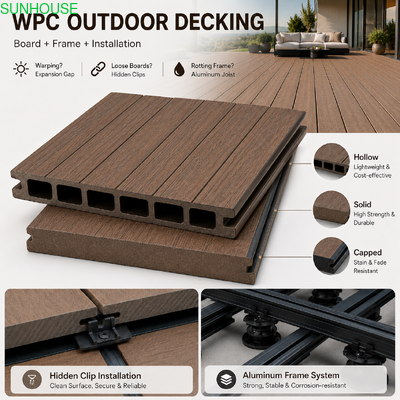
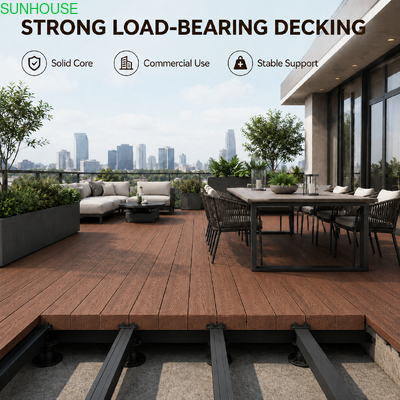
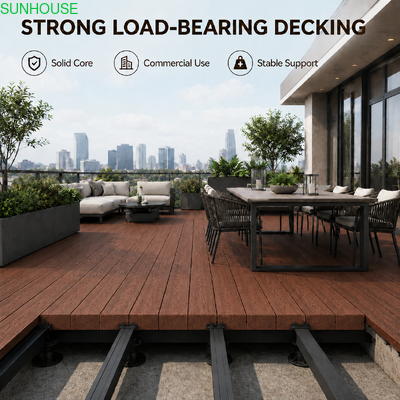
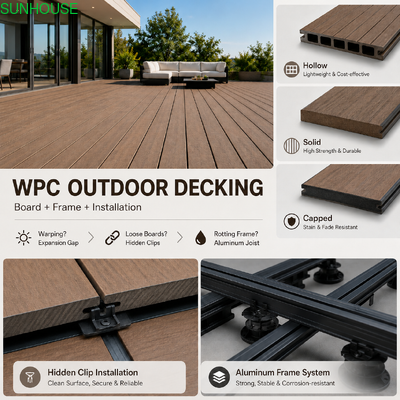
Solid WPC Outdoor Decking Weather Resistance UV Stability And Color Fading Guide
Solid WPC outdoor decking is continuously exposed to sunlight, rain, temperature changes, humidity, dust and seasonal weather conditions. Although WPC decking is designed for outdoor applications, different products can show significant differences in color stability, surface aging, moisture resistance and dimensional movement.
For importers, distributors, contractors and project buyers, weather resistance should be evaluated through the complete material formulation, pigment system, UV stabilizers, surface structure, moisture performance, dimensional stability, installation design and relevant test data.
Buyers should avoid relying only on general claims such as no fading, waterproof, all-weather or maintenance-free. Outdoor performance should be reviewed according to the actual product, project climate and installation conditions.
1. What Does Weather Resistance Mean For Solid WPC Decking?
Weather resistance describes how the decking responds to outdoor environmental exposure over time. It is not one single property and should not be evaluated using one marketing statement.
| Weathering Factor | Possible Effect On Decking | Buyer Evaluation |
|---|---|---|
| Ultraviolet Radiation | Color change, surface chalking or reduced visual uniformity | Review UV or accelerated weathering test information |
| High Temperature | Surface heating, expansion and possible deformation | Check color, profile length and installation-gap requirements |
| Rain And Humidity | Moisture absorption, surface contamination or dimensional change | Review water absorption and drainage requirements |
| Cold Temperature | Material contraction and possible increased brittleness | Confirm suitability for the expected climate and installation season |
| Repeated Weather Cycles | Gradual surface and dimensional changes | Request project-relevant durability data |
2. Why Does Outdoor WPC Decking Change Color?
Outdoor color change can result from sunlight, pigment behavior, wood components, surface oxidation, environmental contamination and the gradual stabilization of the exposed surface.
Buyers should distinguish between normal early weathering, unacceptable batch inconsistency and serious long-term surface degradation.
1Initial Weathering
Some decking surfaces may experience an initial tone adjustment after outdoor exposure as the surface begins to stabilize.
2Long-Term Color Change
Continued sunlight and weather exposure may gradually alter the color, especially when the pigment and stabilization system is insufficient.
3Uneven Exposure
Areas under furniture, roofs or shade may weather differently from fully exposed decking.
4Batch Color Variation
Differences visible before installation may come from pigments, raw materials or production conditions rather than natural weathering.
3. Is Color Fading Normal For WPC Decking?
Some degree of appearance change should be expected from most outdoor decorative materials. The important purchasing questions are how much change occurs, how quickly it occurs and whether the change remains reasonably uniform.
| Color Condition | Possible Interpretation | Recommended Buyer Action |
|---|---|---|
| Slight Uniform Tone Change | May represent normal outdoor surface stabilization | Compare with supplier guidance and weathering data |
| Strong Uneven Fading | May indicate inconsistent formulation, surface protection or exposure | Review production batches and site conditions |
| Color Difference Before Installation | Likely production or batch inconsistency | Separate batches and compare with the approved sample |
| Color Difference Under Furniture | Covered areas receive less sunlight and weather exposure | Set realistic maintenance and appearance expectations |
| Surface Chalking Or Powdering | May indicate more serious surface degradation | Request technical evaluation and relevant test evidence |
4. Understand The Role Of UV Stabilizers
UV stabilizers and light-resistant pigments can help reduce the rate of outdoor color and surface change. Their effectiveness depends on the type, dosage, compatibility and complete decking formulation.
- Ask whether the product formula includes an outdoor stabilization package.
- Confirm that the mass-production formula matches the tested product.
- Check whether different colors use different pigment systems.
- Request weathering data for the actual color being ordered where available.
- Avoid assuming that one test result represents every decking color.
- Confirm whether the protective system is in the complete core or mainly in the surface layer.
5. Compare Traditional And Co-Extruded Solid WPC Decking
Solid WPC decking can be supplied as a traditional uncapped profile or with a co-extruded protective layer. The internal profile may be solid in both cases, but the exposed surface structures are different.
| Comparison Point | Traditional Solid WPC | Co-Extruded Solid WPC |
|---|---|---|
| Visible Surface | The core material forms the finished surface | A separate protective layer covers selected faces |
| Color Control | Depends on the complete core formula and pigment system | Depends strongly on the cap-layer material and pigments |
| Weathering Focus | Surface oxidation, pigment stability and core exposure | Cap-layer stability, adhesion, coverage and color consistency |
| Surface Damage | Damage exposes material similar to the visible surface | Deep damage may expose a different-colored core |
| Inspection Requirement | Check formula, surface texture and weathering data | Check both core quality and protective-layer performance |
6. Inspect The Co-Extruded Protective Layer
For co-extruded solid WPC decking, the protective surface layer should be uniform, well bonded and present on all faces promised in the specification.
- Cut samples at different positions and inspect the visible cap layer.
- Confirm whether the top, sides and bottom are covered.
- Check the cap layer around side grooves and board edges.
- Look for missing areas, bubbles, separation and uneven color lines.
- Test whether normal cutting or bending causes separation from the core.
- Compare cap appearance between the beginning, middle and end of the production batch.
- Confirm that the approved sample uses the same cap material as mass production.
7. How Decking Color Affects Surface Temperature
Dark decking colors generally absorb more solar energy than lighter colors and may become warmer under direct sunlight. The practical surface temperature also depends on local climate, airflow, shading, installation height and surrounding materials.
Dark Brown And Charcoal
Can create a strong modern appearance but may feel warmer under intense direct sunlight.
Light Oak And Gray
May provide a lower perceived heat level in highly exposed areas, depending on the surface system.
Shaded Areas
Shading can reduce surface heating but may also create different weathering between exposed and covered sections.
Poolside Applications
Surface temperature, wet slip performance and barefoot comfort should all be evaluated.
8. Check Batch Color Consistency Before Shipment
Color consistency should be checked before installation because different production batches may weather differently after outdoor exposure.
- Prepare an approved physical reference sample with the exact color and surface finish.
- Select boards from the beginning, middle and end of production.
- Compare boards from different bundles and pallet positions.
- Place several boards side by side under the same natural lighting.
- Check color tone, wood grain, embossing depth and gloss consistency.
- Record production batch numbers and package them separately where necessary.
- Retain same-batch spare boards for future project replacement.
9. Review Accelerated Weathering Test Reports
Accelerated weathering testing can help compare material formulations under controlled laboratory conditions. However, laboratory exposure does not perfectly reproduce every outdoor climate.
| Report Item | What Buyers Should Check | Common Risk |
|---|---|---|
| Tested Product | Profile, color, surface type and material structure | The report may cover another product or color |
| Test Method | Full standard or laboratory procedure | A vague weather-resistant statement cannot be compared |
| Exposure Duration | Number of cycles or hours under the test conditions | Short exposure may not support long-term marketing claims |
| Light Source | Type of artificial weathering source used | Different methods may produce different results |
| Moisture Cycle | Whether water spray, condensation or humidity was included | The test may evaluate light only rather than combined weathering |
| Measured Results | Color change, cracking, chalking or other reported properties | A report may show exposure without clear performance data |
| Before And After Photos | Visual comparison under controlled conditions | Lighting differences can make photographs misleading |
10. Understand The Limits Of Accelerated Weathering Tests
Accelerated laboratory testing is useful for product comparison and quality control, but it should not automatically be converted into a guaranteed number of outdoor service years.
- Laboratory light sources do not reproduce every natural sunlight condition.
- Real projects experience dirt, shade, standing water, chemicals and uneven exposure.
- Local temperature and altitude can affect ultraviolet intensity.
- Installation design can influence drainage and thermal movement.
- Different colors may respond differently under the same test conditions.
- Maintenance practices can influence the visible condition of the deck.
11. Check Water Absorption And Moisture Stability
WPC decking is commonly selected because it generally absorbs less water than untreated natural timber. However, water absorption can still vary according to wood content, polymer encapsulation, density, surface protection and cut-edge exposure.
| Moisture Test Item | Buyer Question |
|---|---|
| Water Absorption | Which test method and exposure period were used? |
| Thickness Change | Was dimensional change measured after water exposure? |
| Weight Change | How much moisture was absorbed under the specified conditions? |
| Surface Condition | Were cracking, swelling, whitening or delamination observed? |
| Recovery | Was the sample evaluated after drying or conditioning? |
| Cut-End Exposure | Does the test represent the actual installed board condition? |
12. Prevent Standing Water Beneath The Deck
Long-term outdoor durability depends on the complete installation system. Poor drainage can create dirt accumulation, biological growth, staining, corrosion of fasteners and maintenance problems.
- Provide a stable and properly drained substrate.
- Maintain suitable clearance beneath the decking.
- Avoid blocking water movement with adhesive, debris or incorrect framing.
- Keep side gaps and perimeter areas clear where required.
- Coordinate the joist direction with the drainage direction.
- Do not allow board ends to remain continuously submerged.
- Inspect drains regularly in rooftop and balcony applications.
13. Evaluate Thermal Expansion And Contraction
Solid WPC decking contains a relatively high volume of composite material and can expand or contract as temperature changes. Long boards and dark colors may require particularly careful movement planning.
Board Length
Longer boards can produce a greater total amount of end movement than shorter sections.
Installation Temperature
Gap requirements may differ when decking is installed during very hot or cold conditions.
Color And Sunlight
Dark, fully exposed decking may reach a higher surface temperature than light or shaded decking.
Fixed Boundaries
Walls, columns, curbs and other fixed structures must not prevent the required board movement.
- Request profile-specific expansion and installation guidance.
- Confirm whether recommendations change according to board length.
- Record site temperature during installation.
- Maintain side, end and perimeter clearances.
- Use approved clips that allow controlled board positioning.
- Provide support at board ends and butt joints.
- Do not force the decking tightly into a fixed space.
14. Check Heat Distortion And Dimensional Stability
High outdoor temperatures can affect the dimensions and stiffness of composite decking. The installed board is also influenced by joist spacing, ventilation, color and exposure to reflected heat.
| Risk Factor | Possible Effect | Recommended Prevention |
|---|---|---|
| Excessive Joist Spacing | Higher deflection when the decking becomes warm | Follow profile-specific support spacing |
| Restricted Expansion | Bowing, end pressure or uneven joints | Maintain required movement clearances |
| Poor Ventilation | Heat accumulation beneath the decking | Provide sufficient airflow below the deck |
| Reflected Heat | Localized high temperature near glass or metal surfaces | Evaluate the specific project environment |
| Dark Color | Higher surface-temperature potential | Consider climate, shading and user comfort |
15. Consider Cold Climate And Freeze-Thaw Conditions
Cold climates create different purchasing and installation concerns. Materials may become less flexible at low temperatures, while moisture and repeated freeze-thaw cycles can affect the complete deck system.
- Confirm the supplier's recommended installation temperature range.
- Handle boards carefully during cold-weather unloading and cutting.
- Review low-temperature impact or conditioning information where required.
- Prevent water from remaining trapped around joints and fasteners.
- Use suitable corrosion-resistant fixing accessories.
- Confirm that snow-removal methods will not damage the decking surface.
- Avoid aggressive metal tools that may scratch or cut the protective layer.
16. Select Decking For Hot And High-UV Climates
Tropical, desert, high-altitude and strongly exposed locations may place greater demands on the pigment, UV stabilization and installation system.
| Climate Condition | Main Purchasing Concern | Recommended Review |
|---|---|---|
| Strong Direct Sunlight | Color change and surface temperature | Review weathering data for the exact color |
| High Altitude | Potentially stronger UV exposure | Confirm project-specific suitability |
| High Heat | Expansion, deflection and user comfort | Review color, ventilation and joist spacing |
| High Humidity | Moisture, staining and biological growth | Provide drainage, airflow and regular cleaning |
| Heavy Rainfall | Standing water and substructure drainage | Review deck slope and drainage paths |
17. Select Decking For Coastal And Poolside Projects
Coastal and poolside projects should be evaluated as complete systems. Salt, pool chemicals, moisture, strong sunlight and wet-foot traffic can affect decking, fasteners and maintenance requirements.
- Confirm corrosion resistance for clips and screws.
- Review wet slip performance for the selected surface texture.
- Check resistance to expected cleaning agents and pool chemicals.
- Provide drainage beneath and around the decking.
- Evaluate color and surface temperature for barefoot areas.
- Wash away salt or chemical residue according to maintenance guidance.
- Confirm whether the warranty contains restrictions for poolside or coastal use.
18. Understand Surface Chalking, Cracking And Erosion
Color fading is not the only sign of outdoor aging. Buyers should also inspect whether the surface becomes powdery, cracked, rough or uneven after weather exposure.
| Surface Condition | Possible Cause | Buyer Evaluation |
|---|---|---|
| Chalking | Surface degradation produces a powdery residue | Review weathering results and surface formulation |
| Fine Cracking | Weathering, stress or unsuitable formulation | Inspect tested samples and outdoor reference projects |
| Surface Erosion | Loss of exposed surface material over time | Check texture retention and material stability |
| Cap-Layer Separation | Weak co-extrusion bonding or production control | Inspect adhesion and cut cross-sections |
| Uneven Gloss | Weathering, contamination or inconsistent production | Compare multiple boards under the same lighting |
19. Check Whether The Test Report Matches The Order
A weathering report is only useful when the tested product represents the decking being purchased. Differences in color, cap layer, profile, formula or surface treatment may affect the result.
Report Matching Checklist
- Supplier and manufacturer name
- Product model and profile number
- Solid WPC profile dimensions
- Traditional or co-extruded surface
- Protected faces and cap-layer structure
- Exact tested color
- Surface texture and embossing
- Test method and exposure conditions
- Measured color-change result
- Surface cracking, chalking or other observations
- Report number, date and issuing laboratory
- Sample photographs and preparation details
20. Approve Outdoor Color Samples Correctly
Digital color charts and indoor samples are useful for initial selection, but the final production color should be approved using a physical decking sample under realistic lighting.
Recommended Color Approval Method
Approve a full-width sample showing the actual profile, wood grain, texture and co-extruded surface. Inspect the sample under indoor light, natural daylight and direct outdoor sunlight where practical.
Label the approved sample with the color code, product model, surface structure, approval date and project reference. This sample should then be used during mass production and pre-shipment inspection.
- Confirm the approved color using a physical sample.
- Review several connected boards rather than one narrow piece.
- Check wood grain repetition and color variation.
- Confirm whether natural multi-tone differences are acceptable.
- Approve fascia boards, stair boards and trims together.
- Keep one approved sample with the buyer and one with the supplier.
21. Review Outdoor Reference Projects Carefully
Existing projects can provide useful supporting information, but photographs alone should not be treated as formal durability evidence.
- Ask when the project was installed.
- Confirm the climate and sunlight conditions.
- Check whether the decking profile and color match the proposed order.
- Ask whether the project is fully exposed or mostly covered.
- Review maintenance and cleaning frequency.
- Request close-up photographs rather than only distant project images.
- Confirm whether damaged or faded boards have already been replaced.
22. Installation Factors That Affect Weather Performance
Product formulation is only one part of outdoor durability. Incorrect installation can create bowing, uneven gaps, standing water and premature surface problems.
| Installation Factor | Possible Weather-Related Problem | Recommended Control |
|---|---|---|
| Joist Spacing | Excessive deflection during hot weather | Follow the approved profile spacing |
| Expansion Gaps | Bowing or end pressure during temperature changes | Use project-specific gap guidance |
| Drainage | Standing water and staining | Maintain drainage paths beneath the deck |
| Ventilation | Heat and moisture accumulation | Provide sufficient clearance and airflow |
| Fasteners | Corrosion or loose decking | Use compatible corrosion-resistant accessories |
| Mixed Production Batches | Uneven color and weathering | Keep one visible area within one controlled batch |
23. Cleaning And Maintenance Affect Appearance
WPC decking is generally designed to require less routine maintenance than natural timber, but it is not maintenance-free. Dirt, leaves, grease, algae and chemical residue can change the visible appearance.
Routine Cleaning
Remove dust, leaves and debris before they accumulate in grooves and gaps.
Stain Removal
Clean spills according to the supplier's recommended method before they remain on the surface.
Biological Growth
Shaded and damp environments may support algae or surface contamination if drainage is poor.
Cleaning Chemicals
Test cleaners on a hidden area and avoid aggressive chemicals unless compatibility is confirmed.
24. Review Warranty Conditions And Exclusions
A long warranty period is not meaningful unless the scope, acceptable color change and installation conditions are clearly defined.
| Warranty Item | What Buyers Should Check |
|---|---|
| Covered Product | Exact model, color, surface and production source |
| Color Change | Whether a measurable limit or visual standard is defined |
| Surface Damage | Whether cracking, chalking or delamination is included |
| Installation Conditions | Required joist spacing, gaps, drainage and fasteners |
| Excluded Environments | Poolside, coastal, submerged or high-heat applications |
| Maintenance Requirements | Cleaning and inspection responsibilities |
| Remedy | Replacement material, credit, labor or freight coverage |
25. Recommended Pre-Purchase Weather Evaluation
- Define the project climate, sunlight, rainfall, temperature range and application.
- Select the solid decking profile, color and traditional or co-extruded surface.
- Request physical samples in the exact product configuration.
- Inspect color under indoor, natural and direct outdoor lighting.
- Review water absorption, weathering and dimensional-stability information.
- Confirm that test reports match the exact profile, surface and color.
- Evaluate joists, clips, screws, drainage and expansion requirements.
- , clips, screws
- Approve a labeled physical sample for mass-production reference.
- Include weather-performance and color requirements in the purchase order.
- Arrange pre-shipment inspection across different bundles and production stages.
26. Weather Performance Purchase Order Checklist
Information Buyers Should Confirm Before Production
- Solid WPC decking profile number
- Board dimensions and weight
- Traditional or co-extruded surface
- Protected faces and cap-layer coverage
- Approved physical color sample
- Pigment and outdoor stabilization requirements
- Acceptable batch color variation
- Weathering test method and result
- Water absorption and dimensional-change data
- Surface cracking, chalking and delamination criteria
- Installation-temperature guidance
- Side, end and perimeter gaps
- Joist type and spacing
- Drainage and ventilation requirements
- Corrosion-resistant clips and screws
- Production batch identification
- Same-batch spare decking quantity
- Warranty scope and exclusions
- Pre-shipment inspection procedure
27. Common Weather Resistance Problems
| Problem | Possible Cause | Recommended Prevention |
|---|---|---|
| Rapid Color Change | Weak pigment or UV stabilization system | Review exact-color weathering data and formula control |
| Uneven Fading | Mixed batches, uneven exposure or inconsistent cap layer | Control production batches and inspect surface coverage |
| Decking Bows In Hot Weather | Restricted expansion, wide joist spacing or insufficient ventilation | Follow profile-specific installation guidance |
| Standing Water Stains | Poor drainage or blocked deck gaps | Improve drainage and clean the system regularly |
| Surface Chalking | Surface degradation from outdoor exposure | Review formulation and accelerated weathering results |
| Cap Layer Separates | Poor bonding or co-extrusion control | Inspect cut sections and adhesion before shipment |
| Replacement Board Does Not Match | Different batch and different weathering history | Keep same-batch spare boards for maintenance |
Common Questions From Solid WPC Decking Buyers
Some outdoor color change can occur. The degree and rate depend on the pigment system, UV stabilization, surface structure, color and exposure conditions.
No outdoor decorative product should be assumed to have zero color change. Buyers should review test data and acceptable color-change limits for the exact product.
Covered areas receive less sunlight and weather exposure, so they may weather at a different rate from fully exposed boards.
Darker colors may absorb more solar energy and become warmer in direct sunlight. Climate, shading and surface formulation also affect temperature.
Not automatically. Laboratory tests are useful for comparison but do not reproduce every real climate, maintenance condition or installation environment.
Water absorption is generally controlled by the material formulation and surface structure. Buyers should review the exact test method and measured results.
It may be suitable when the selected product, installation temperature, impact performance, drainage and expansion requirements match the project climate.
Approve a full-width physical sample in the exact profile, color, texture and surface structure. Digital photographs should not be the only color standard.
Use an approved physical sample, control production batches, inspect boards from different bundles and retain same-batch spare material.
Weather-Resistant Solid WPC Outdoor Decking Supply
We supply solid WPC outdoor decking for distributors, wholesalers, contractors, landscape companies and commercial projects. Multiple profiles, colors, wood grain textures, traditional surfaces, co-extruded protective layers and matching installation accessories are available.
Send us your destination climate, project application, decking dimensions, preferred color, surface structure, quantity and installation conditions for sample evaluation, weather-performance document review and wholesale pricing.
