


 english
 français
 Deutsch
 Italiano
 Русский
 Español
 português
 Nederlandse
 ελληνικά
 日本語
日本語
 한국
한국
 العربية
 हिन्दी
 Türkçe
 indonesia
 tiếng Việt
 ไทย
ไทย
 বাংলা
বাংলা
 فارسی
فارسی
 polski


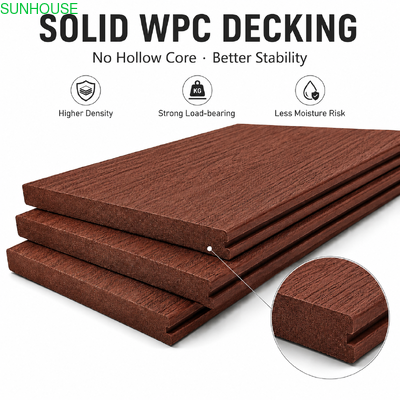
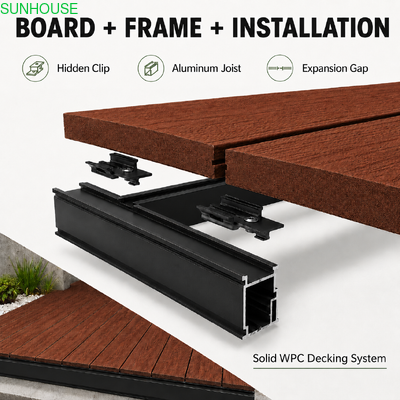
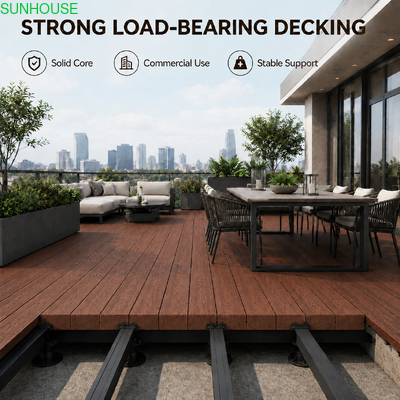
Solid WPC Outdoor Decking Weight Container Loading And Landed Cost Guide For Buyers
Solid WPC outdoor decking contains more composite material than a comparable hollow profile, which normally results in a higher board weight, lower container loading quantity and greater international freight cost per installed square meter.
A low factory price does not always produce the lowest project cost. Importers, distributors, contractors and project buyers should compare the weight per linear meter, weight per square meter, effective coverage, packaging weight, accessory quantity, container payload and complete landed cost.
This guide explains how to compare solid WPC decking quotations using consistent units and how to identify hidden logistics costs before confirming a bulk order.
1. Why Solid WPC Decking Weight Matters
Product weight affects more than ocean freight. It also influences manual handling, bundle design, forklift requirements, container loading, local delivery and installation labor.
1Factory Handling
Heavy boards require suitable production-line handling, bundling and warehouse support.
2Container Payload
Solid decking may reach the permitted loading weight before all available container volume is used.
3Site Installation
Heavy and long boards may require additional workers, lifting tools or shorter carrying distances.
4Inland Delivery
Truck limits, road restrictions and unloading equipment can affect the final logistics plan.
2. Confirm Weight Per Linear Meter
Weight per linear meter is one of the most useful values for comparing decking boards with the same profile dimensions and length.
Example
If one decking board weighs 10.8 kg and is 3.6 meters long:
10.8 kg ÷ 3.6 m = 3.0 kg per linear meter.
This value can then be compared with other suppliers offering the same or similar profile.
- Measure several boards from different production bundles.
- Confirm that the board length used in the calculation is accurate.
- Compare actual dimensions before comparing weights.
- Agree on an acceptable production-weight tolerance.
- Investigate significant weight differences across one production batch.
3. Calculate Weight Per Installed Square Meter
Weight per square meter is more useful than weight per board when comparing different decking widths, lengths and installed gaps.
Calculation Example
Assume the board weighs 3.0 kg per linear meter and the effective installed width, including the designed board gap, is 0.15 meter.
3.0 kg ÷ 0.15 m = 20 kg per installed square meter.
This calculation covers the decking boards only. Joists, clips, screws, fascia and packaging must be calculated separately.
4. Distinguish Overall Width And Effective Installed Width
The physical width of a decking board is not always the same as its installed coverage. Side grooves, hidden clips and the designed gap between boards affect the final coverage.
| Width Term | Meaning | Purchasing Use |
|---|---|---|
| Overall Board Width | Complete physical width of the decking profile | Used for profile verification and packaging calculations |
| Visible Face Width | Top decorative surface visible before installation | Used for visual and design comparison |
| Installed Board Gap | Space created between adjacent boards by clips or spacers | Affects drainage, appearance and total coverage |
| Effective Installed Width | Board coverage plus the designed repeating gap | Used for project quantity and cost-per-square-meter calculations |
5. Compare Solid Decking Weight With Hollow Decking
Solid profiles generally use more composite material than hollow profiles with similar external dimensions. This often results in higher weight and lower container loading efficiency.
| Comparison Point | Solid WPC Decking | Hollow WPC Decking |
|---|---|---|
| Material Volume | Higher | Reduced by engineered chambers |
| Weight Per Meter | Usually higher | Usually lower |
| Manual Handling | More demanding | Generally easier |
| Container Loading | More likely to be limited by weight | May allow more square meters per container |
| Freight Per Square Meter | Often higher | Can be lower when loading efficiency is better |
| Product Selection | Should provide a verified project advantage | Can offer an efficient balance of performance and logistics |
6. Do Not Use Weight As The Only Quality Standard
High board weight can result from more material, greater dimensions, higher density or increased mineral filler content. These causes do not provide the same performance.
| Weight Condition | Possible Cause | Additional Verification |
|---|---|---|
| Heavy And Tough | Balanced material formula and substantial profile | Review bending, impact and dimensional stability |
| Heavy But Brittle | Possible excessive mineral filler or poor formula balance | Test cutting, drilling and edge impact |
| Light With Large Pores | Possible unstable extrusion or internal gas release | Inspect cut cross-sections |
| Inconsistent Weight | Material feeding or dimensional variation | Sample boards across the production batch |
7. Understand Net Weight And Gross Weight
Net weight normally refers to the product itself, while gross weight includes packaging materials. Buyers should confirm both values before planning container loading.
Net Product Weight
Includes decking boards and separately listed accessories where stated in the packing list.
Gross Package Weight
Includes decking, cartons, protective film, pallets, support beams, strapping and other packaging.
Container Cargo Weight
Total gross weight of all loaded products and packaging inside the container.
Total Transport Weight
May also include the container tare weight when road or terminal weight limits are reviewed.
8. Include Joists And Accessories In The Weight Plan
A decking order is not complete without joists, hidden clips, screws, starter clips, fascia and spare parts. These items can use a meaningful part of the container payload.
| Order Component | Weight Calculation Basis |
|---|---|
| Decking Boards | Linear meters × kilograms per linear meter |
| Joists | Total joist length × kilograms per meter |
| Hidden Clips | Total clip quantity × unit weight |
| Screws | Total screw quantity × unit weight plus packaging |
| Fascia Boards | Total perimeter length × fascia weight per meter |
| Spare Material | Additional percentage or confirmed board quantity |
| Packaging | Pallets, cartons, film, straps and support materials |
9. Understand Container Weight And Volume Limits
Container loading is controlled by both available internal space and permitted transport weight. Solid WPC decking frequently becomes weight-limited rather than volume-limited.
Volume-Limited Loading
The container becomes physically full before the permitted cargo weight is reached.
Weight-Limited Loading
The permitted cargo weight is reached while unused internal volume remains.
10. Compare 20GP And 40HQ Loading Carefully
A larger container does not always provide a proportionally higher loading quantity for heavy solid WPC decking. The container may reach its transport-weight limit before the additional volume can be used.
| Container Consideration | 20GP | 40HQ |
|---|---|---|
| Internal Volume | Lower | Higher |
| Decking Length Compatibility | Depends on board length and loading direction | May provide more layout options |
| Heavy Solid Decking | Can offer efficient weight utilization | May reach weight limit before full volume is used |
| Mixed Loading | Less space for multiple profiles and accessories | More volume but weight still requires control |
| Freight Comparison | Compare freight per loaded square meter | Do not compare container price alone |
11. Calculate Estimated Container Loading Quantity
A preliminary loading estimate can be calculated from the permitted cargo weight and gross weight per installed square meter.
Illustrative Example
Assume the available cargo weight is 24,000 kg and the complete packed decking system averages 24 kg per installed square meter.
24,000 kg ÷ 24 kg/m² = approximately 1,000 m².
The actual quantity may be lower because of package dimensions, load distribution, accessories and container-layout limitations.
12. Check Loading Quantity By Both Pieces And Square Meters
A packing list that shows only the number of decking boards does not tell the buyer how much project area can actually be installed.
- Confirm pieces per bundle.
- Confirm bundles per container.
- Calculate total linear meters.
- Convert linear meters into installed square meters.
- Include the designed board gap.
- List joists and accessories separately.
- Confirm total net and gross cargo weight.
13. Review Board Length And Loading Efficiency
Board length affects container arrangement, handling, cutting loss and package stability. The longest available board is not always the most economical option.
| Board Length Factor | Possible Cost Effect |
|---|---|
| Longer Boards | May reduce project joints but increase handling and packaging requirements |
| Shorter Boards | May improve handling but create more butt joints and cutting planning |
| Custom Lengths | Can reduce site waste but may require a higher MOQ or production setup cost |
| Mixed Lengths | May improve loading or project utilization but require clear packing identification |
| Excessive Length | Can create container, site access or inland-transport limitations |
14. Evaluate Packaging Weight And Protection
Packaging adds weight but is necessary to protect heavy solid decking from surface scratches, edge damage and movement during shipping.
| Packaging Component | Main Function | Buyer Confirmation |
|---|---|---|
| Protective Film | Reduces surface scratches and contamination | Check removal method and residue risk |
| Carton Or Wrapping | Groups boards and protects finished surfaces | Confirm material strength and pieces per package |
| Bottom Supports | Keep long boards supported during storage and lifting | Check support spacing and forklift access |
| Edge Protection | Protects corners, side grooves and cut ends | Inspect both ends after unloading |
| Strapping | Prevents package movement | Ensure straps do not crush or mark the decking |
| Pallets | Improve mechanical handling and warehouse storage | Include pallet weight in gross-weight calculations |
15. Plan Weight Distribution Inside The Container
Heavy decking should be loaded with balanced weight distribution. Concentrating excessive weight in one area can create handling, safety and transport problems.
- Distribute heavy bundles evenly across the container floor.
- Use suitable support materials beneath long bundles.
- Prevent movement during ocean and road transport.
- Keep container doors accessible and safely loaded.
- Confirm forklift and unloading requirements at destination.
- Avoid stacking that damages lower bundles.
- Record bundle positions when multiple colors or profiles are mixed.
16. Include Inland Transport Restrictions
A container may be acceptable for ocean transport but exceed local road, chassis or truck restrictions after arrival.
| Transport Stage | Possible Weight Requirement |
|---|---|
| Factory To Origin Port | Local truck, axle and road restrictions |
| Port Handling | Terminal and lifting-equipment limits |
| Ocean Shipping | Container and carrier acceptance |
| Destination Port To Warehouse | Local road, chassis and permit requirements |
| Final Site Delivery | Site access, unloading space and lifting equipment |
17. Understand The Main Landed Cost Components
Landed cost is the total cost of bringing the complete decking system to the buyer's warehouse or project location.
18. Calculate Landed Cost Per Installed Square Meter
The most useful comparison unit is the complete landed cost per installed square meter.
Illustrative Example
Assume the complete shipment cost is USD 35,000 and the container provides 1,000 m² of usable installed decking after confirmed cutting and spare allowance.
USD 35,000 ÷ 1,000 m² = USD 35 per installed square meter.
This value is more useful than comparing only the FOB price per board.
19. Use Usable Project Area Instead Of Shipped Area
Not every shipped square meter becomes usable installed area. Buyers should account for cutting, damaged pieces, pattern layout and spare material.
| Quantity Adjustment | Reason |
|---|---|
| Cutting Loss | Boards must be trimmed around edges, stairs, posts and irregular areas |
| Pattern Loss | Diagonal, herringbone or picture-frame designs require additional cutting |
| Transport Damage | Some boards may become unusable after handling or impact |
| Color Selection | Boards with unacceptable color differences may be separated |
| Future Spare Material | Same-batch boards may be retained for later repair |
20. Compare FOB, CIF And DDP Quotations Correctly
Different trade terms include different cost responsibilities. Buyers should not compare two quotations without identifying which transport and import costs are included.
| Quotation Basis | General Purchasing Focus |
|---|---|
| EXW | Buyer arranges collection from the factory and most transport stages |
| FOB | Confirm ocean freight, insurance and all destination costs separately |
| CIF | Confirm what destination handling, duty and inland delivery remain excluded |
| DDP Or Delivered Offer | Confirm tax treatment, unloading, delivery address and excluded site services |
21. Compare Supplier Quotations Using One Standard Format
Suppliers may quote per piece, per meter, per square meter or per container. Convert every quotation into the same basis before making a decision.
| Comparison Item | Supplier A | Supplier B | Supplier C |
|---|---|---|---|
| Profile Dimensions | Confirm | Confirm | Confirm |
| Effective Installed Width | Record | Record | Record |
| Weight Per Linear Meter | Record | Record | Record |
| Weight Per Installed Square Meter | Calculate | Calculate | Calculate |
| Square Meters Per Container | Confirm | Confirm | Confirm |
| Complete Accessory Cost | Add | Add | Add |
| Freight Per Square Meter | Calculate | Calculate | Calculate |
| Total Landed Cost | Calculate | Calculate | Calculate |
22. Hidden Costs Buyers Often Miss
- Starter clips and finishing clips
- Double joists at board-end joints
- Additional joists for diagonal installation
- Fascia boards and stair components
- Special corrosion-resistant screws
- Reinforced packaging for heavy solid boards
- Pre-shipment inspection charges
- Destination terminal and documentation fees
- Container overweight or special transport permits
- Warehouse unloading and forklift costs
- Project cutting loss and spare boards
- Replacement freight for damaged or missing accessories
23. Compare Freight Cost Per Square Meter
Ocean freight should be divided by the actual installed square meters loaded in the container.
When comparing solid and hollow WPC decking, the solid product may have a similar factory price per square meter but a higher freight cost because fewer square meters fit within the permitted cargo weight.
24. Evaluate Mixed Container Loading
Buyers may combine decking colors, joists, wall panels or accessories in one container. Mixed loading can improve purchasing flexibility but may reduce loading efficiency.
| Mixed Loading Factor | Possible Effect |
|---|---|
| Multiple Decking Lengths | Can create unused spaces and more complicated bundle layouts |
| Multiple Colors | Requires clear labels and separate bundle identification |
| Decking And Joists | Different package sizes may reduce stacking efficiency |
| Light And Heavy Products | Requires careful weight distribution |
| Fragile Accessories | May require protected loading positions |
25. Request A Detailed Loading Plan
Before production, buyers should request a preliminary container-loading plan showing the complete order.
Recommended Loading Plan Information
- Container type
- Decking model, color and length
- Pieces per bundle
- Number of bundles
- Linear meters per container
- Installed square meters per container
- Decking net weight
- Joist and accessory weight
- Packaging weight
- Total gross cargo weight
- Package dimensions
- Bundle arrangement
- Mixed-loading details
- Remaining weight and volume allowance
26. Verify Loading Quantity Before Shipment
- Confirm the final produced quantities and board lengths.
- Weigh representative boards and compare them with the approved specification.
- Confirm pieces and gross weight per bundle.
- Check joists, clips, screws, fascia and spare materials.
- Verify package dimensions and labels.
- Recalculate the total container cargo weight.
- Confirm transport-weight limits with the freight forwarder.
- Supervise loading and balanced bundle distribution.
- Check the final packing list against the loaded cargo.
- Retain loading photos and weight records.
27. Common Container Loading Problems
| Problem | Possible Cause | Recommended Prevention |
|---|---|---|
| Fewer Square Meters Than Expected | Weight per meter or packaging weight was underestimated | Confirm actual production weights before loading |
| Container Reaches Weight Limit Early | Heavy solid decking and accessories consume payload quickly | Compare 20GP and 40HQ loading plans in advance |
| Unused Container Space | Cargo is weight-limited or package dimensions are inefficient | Optimize bundle dimensions and mixed-loading arrangement |
| Boards Damaged At Destination | Insufficient support, strapping or edge protection | Approve packaging and loading photos before shipment |
| Accessories Missing | They were calculated separately but not included in the packing list | Use a complete system checklist |
| High Inland Delivery Cost | Shipment exceeds standard local transport limits | Confirm destination transport before factory loading |
28. Common Landed Cost Calculation Errors
| Calculation Error | Why It Creates A Wrong Result |
|---|---|
| Comparing Price Per Board | Board lengths, widths and effective coverage may be different |
| Ignoring Board Gaps | Installed coverage is calculated incorrectly |
| Using Net Weight Only | Packaging and accessory weight reduce available payload |
| Ignoring Cutting Loss | Shipped area is treated as fully usable project area |
| Excluding Joists And Clips | The quotation does not represent a complete installation system |
| Comparing Container Freight Only | Containers may carry different installed square meters |
| Ignoring Destination Charges | FOB or CIF price is mistaken for final delivered cost |
29. Recommended Supplier Quotation Requirements
Information Buyers Should Request
- Solid WPC decking profile drawing
- Board dimensions and length
- Overall width and effective installed width
- Board weight per linear meter
- Decking weight per installed square meter
- Pieces and square meters per bundle
- Bundle net weight and gross weight
- Joist quantity and weight
- Clip, screw and accessory quantities
- Packaging dimensions and weight
- 20GP loading quantity
- 40HQ loading quantity
- Total cargo weight per container
- FOB, CIF or delivered quotation scope
- Freight-validity period
- Estimated landed cost per square meter
- Cutting and spare-material allowance
- Loading plan and packing-list format
30. Recommended Purchasing Decision Process
- Confirm the project area, layout, cutting loss and spare-material requirement.
- Select the exact solid WPC decking profile and installation system.
- Calculate required linear meters using the effective installed width.
- Confirm decking, joist, clip, screw and fascia quantities.
- Calculate product and system weight per installed square meter.
- Request 20GP and 40HQ loading calculations.
- Confirm ocean and inland transport-weight limits.
- Compare freight and total landed cost per installed square meter.
- Include all cost and loading assumptions in the purchase contract.
- Verify production weight, packing and loading before shipment.
Common Questions From Solid WPC Decking Buyers
Solid profiles contain more composite material and normally have a higher weight per installed square meter, reducing the quantity that can be loaded within container-weight limits.
No. Board length, width and effective installed coverage may differ. Price should be converted into cost per installed square meter.
Not necessarily. Heavy solid decking may reach the permitted cargo weight before the larger container volume is fully used.
Request weight per board, weight per linear meter, weight per installed square meter, bundle net weight, bundle gross weight and total container cargo weight.
Yes. Joists, clips, screws, fascia, spare boards and packaging all use part of the available cargo payload.
Divide the total ocean freight by the installed square meters loaded in the container rather than comparing the container freight rate alone.
It is the total product, accessory, packaging, freight, import and delivery cost divided by the usable installed project area.
Actual production weight, package dimensions, accessory quantities and transport restrictions may differ from the preliminary estimate.
No. Higher weight may result from more material or increased mineral filler. Strength, toughness, dimensional stability and installation performance should also be verified.
Solid WPC Decking Loading And Cost Calculation Support
We supply solid WPC outdoor decking with matching joists, hidden clips, screws, fascia boards and installation accessories for distributors, contractors, landscape companies and commercial projects.
Send us your project area, decking profile, board length, color, installation layout, destination port and order quantity for product-weight calculation, container-loading planning and wholesale cost comparison.
