
5s
+1
Submission successful!

|
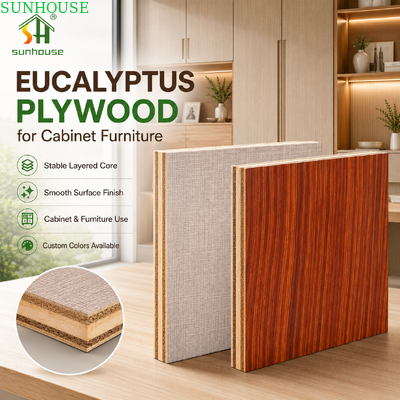
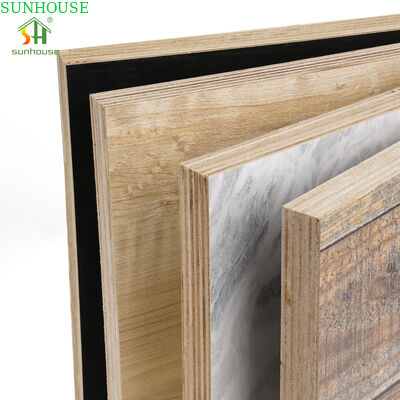
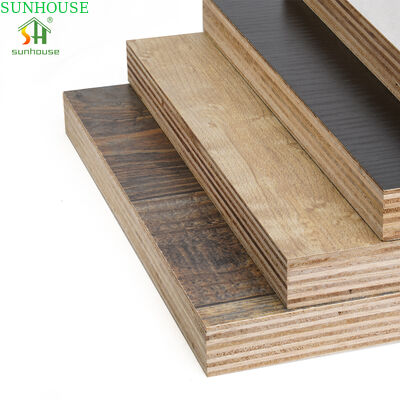
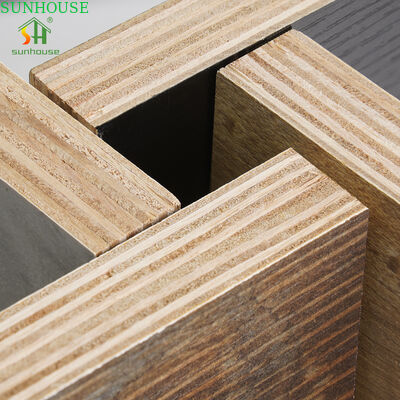
| Brand Name: | SUNHOUSE |
| Model Number: | ply-19 |
| MOQ: | 1000 |
| Payment Terms: | T/T |
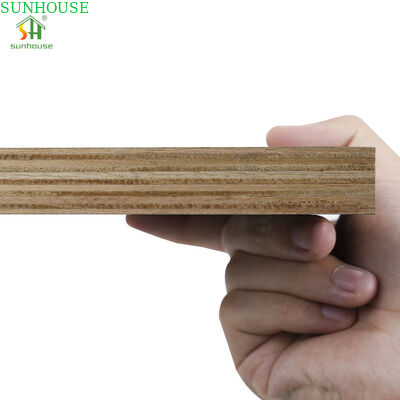
A melamine plywood panel can look perfectly smooth from the outside while still containing gaps, overlaps or poorly connected veneers inside the core. These internal defects may remain invisible until the board is cut, drilled, routed or edge banded during furniture production.
For cabinet manufacturers, furniture factories and bulk plywood buyers, checking the internal core structure is therefore an important part of evaluating real board quality.
Melamine faced plywood is covered by a decorative surface, so buyers cannot judge the complete internal structure simply by looking at the front and back of a full sheet.
Problems such as veneer gaps, overlapping veneers, broken core sections or inconsistent inner layers may only become visible after the board enters furniture production.
Core quality influences whether the same board can deliver stable processing performance across hundreds or thousands of furniture components.
Plywood is manufactured by bonding multiple wood veneer layers together. Ideally, the internal veneers should provide continuous and relatively uniform support throughout the panel.
A core void occurs when part of the internal veneer structure contains an excessive empty space or insufficient wood support. Small natural variations can occur in plywood, but large or frequent voids can create problems in furniture manufacturing.
Spaces between adjacent inner veneers can leave unsupported areas inside the plywood core.
Excessive overlapping can create uneven thickness and local high points inside the panel.
Damaged or incomplete internal veneers may reduce consistency along cut edges and fixing areas.
| Processing Step | More Uniform Core | Potential Risk From Large Voids |
|---|---|---|
| Cutting | Cleaner and more consistent edge structure | Visible holes and irregular internal areas |
| CNC Routing | More predictable machining result | Unexpected hollow areas become exposed |
| Drilling | More material around fixing positions | Drilling may reach an unsupported area |
| Screw Fixing | More consistent fixing conditions | Reduced support in local hollow sections |
| Edge Banding | More continuous edge support | Local depressions or uneven edges |
| Furniture Assembly | More predictable component quality | Quality can vary from piece to piece |
Plywood is a natural wood-based panel made from veneers. The goal of quality control is not to claim that every panel contains absolutely zero natural variation.
What matters for furniture production is the size, frequency and distribution of internal defects and whether they affect the required processing and final application.
Professional buyers should evaluate actual cut samples, production consistency and agreed quality grades instead of relying only on absolute promotional statements.
Full-sheet appearance alone is not enough. Buyers can use several simple checks to understand the internal construction before confirming mass production.
Core quality is closely related to raw veneer selection, veneer grading, patching, lay-up control and manufacturing consistency.
Lower-priced plywood may use different core grades or allow more internal variation. This does not mean every economical plywood is unsuitable, but buyers should understand exactly which quality level is being quoted.
| Cost Factor | Why It Affects the Board |
|---|---|
| Veneer Grade | Better selected core veneers generally require more raw material control. |
| Core Repair | Veneer gaps and damaged areas may require additional sorting or repair. |
| Lay-Up Accuracy | Better veneer alignment helps control gaps and excessive overlaps. |
| Quality Inspection | More consistent production requires tighter process and final inspection. |
| Rejected Material | Higher quality grades normally allow fewer unacceptable internal defects. |
The more cutting, drilling, routing and fixing required by the final furniture, the more important internal core consistency becomes.
A smooth melamine surface is important, but it represents only one part of the finished plywood panel.
For furniture manufacturers and cabinet factories, inspecting the internal core structure can help reduce unexpected problems during cutting, CNC machining, drilling, fixing and edge banding.
Before comparing quotations, buyers should confirm the core grade and processing requirements so that different suppliers are quoting a genuinely comparable product.
Send us your required thickness, core type, furniture application and processing method. Cut-edge samples and suitable plywood grades can be matched according to your CNC, drilling, edge banding and furniture production requirements.
Request Cut Sample & Quotation

 english
 français
 Deutsch
 Italiano
 Русский
 Español
 português
 Nederlandse
 ελληνικά
 日本語
日本語
 한국
한국
 العربية
 हिन्दी
 Türkçe
 indonesia
 tiếng Việt
 ไทย
ไทย
 বাংলা
বাংলা
 فارسی
فارسی
 polski
