
5s
+1
Submission successful!

|
| Brand Name: | SUNHOUSE |
| Model Number: | Customized |
| Payment Terms: | L/C,T/T |
BWP (Boiling Water Proof) is a common trade expression used in some markets for plywood designed to provide high resistance to wet conditions. The actual bonding performance should be evaluated through applicable standards, testing procedures and product documentation.
BWP plywood is commonly specified for applications requiring durable bonding under demanding moisture conditions. It is manufactured by bonding multiple veneer layers together using an adhesive system selected for the intended end use.
However, the term BWP does not automatically represent one universal international certification. Different manufacturers and markets may apply different testing methods and acceptance requirements.
For accurate product comparison, buyers should identify the applicable bonding standard, test method, conditioning procedure, sample construction and acceptance criteria.
Do not evaluate BWP plywood based only on its product name. Always check the actual bonding standard and supporting laboratory test reports.
A meaningful plywood bonding test report should provide enough information to identify the tested product, reproduce the testing conditions and evaluate the result.
Exact standard number and edition, rather than a general statement such as passed water testing.
Panel thickness, veneer construction, adhesive system, production batch and sampling date.
Water temperature, treatment duration, conditioning cycles and specimen preparation where applicable.
Shear strength, wood failure percentage and the acceptance criteria required by the selected standard.
ASTM D906 provides a method for comparing adhesive shear strength in plywood-type construction under specified specimen preparation and test conditions. It is a test method, not a general waterproof certification.
Before placing an order, buyers should establish the following technical requirements with the manufacturer.
| Technical Item | Buyer Requirement | Documentation Required |
|---|---|---|
| Product Type | BWP / Boiling Water Resistant Plywood | Product specification |
| Bonding Standard | EN 314-2 / ISO 12466-2 / Applicable Project Standard | Standard edition and class |
| Test Method | Agreed testing and conditioning procedure | Complete laboratory report |
| Adhesive Type | Manufacturer-declared resin system | Technical declaration |
| Panel Construction | Core species, ply count, thickness and grade | Production specification |
| Acceptance Criteria | Required test values and pass/fail requirements | Applicable standard or project clause |
| Product Identification | Batch number and production information | Traceability record |
BWP and WBP are commonly used expressions in the international plywood trade. However, buyers should compare the actual technical requirements and test evidence rather than assume that these abbreviations always represent identical performance.
APA distinguishes Exterior panels from Exposure 1 panels according to their intended moisture exposure. Exterior panels are designed for long-term weather exposure, while Exposure 1 panels are intended for limited moisture exposure, such as during construction.
EN 314-2 and ISO 12466-2 address plywood bonding quality requirements. These standards have their own testing procedures and classifications.
Bonding quality and exposure classification should be supplied in accordance with the specified standard and edition, supported by a test report for the offered plywood construction.
When evaluating a BWP plywood supplier, buyers should verify that the technical information corresponds to the actual product being quoted.
BWP and WBP are often used similarly in commercial plywood descriptions. However, buyers should not assume that they represent identical testing requirements. Always confirm the applicable bonding standard, test method and supporting documentation.
No. A laboratory boiling water test evaluates plywood under defined testing conditions. It does not automatically establish suitability for permanent water immersion, biological durability or every outdoor environment. Proper product selection, installation and surface protection remain important.
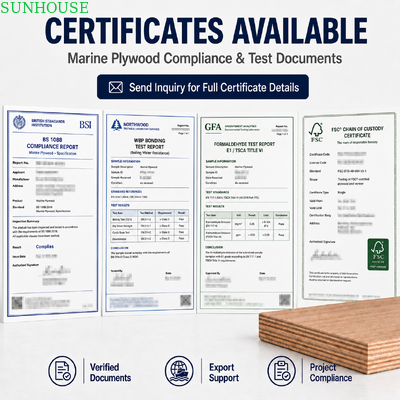
Suppliers should provide genuine technical documents that apply to the offered plywood product. Depending on the applicable requirements, these may include laboratory test reports, product conformity documents and production quality records. Buyers should verify the document issuer, test standard, sample details and validity.
Bonding quality depends on adhesive selection, veneer preparation, adhesive application, assembly conditions, pressing parameters and manufacturing quality control. The finished panel should be evaluated using the applicable bonding test method.
BWP plywood may be suitable for different furniture and construction applications depending on its panel grade, bonding performance, mechanical properties, surface finish and intended exposure. Always match the product specification to the actual project requirements.
The following public technical references provide further information about plywood bonding quality, adhesive testing and moisture exposure classifications.
These references explain general technical requirements. Actual product compliance must be established through documents and test results applicable to the supplied plywood construction.
SUNHOUSE provides plywood product options for furniture, construction and industrial applications. Contact our team to discuss core materials, panel thickness, dimensions, bonding requirements and export packaging.


 english
 français
 Deutsch
 Italiano
 Русский
 Español
 português
 Nederlandse
 ελληνικά
 日本語
 한국
 العربية
 हिन्दी
 Türkçe
 indonesia
 tiếng Việt
 ไทย
 বাংলা
 فارسی
 polski
