


 english
 français
 Deutsch
 Italiano
 Русский
 Español
 português
 Nederlandse
 ελληνικά
 日本語
 한국
 العربية
 हिन्दी
 Türkçe
 indonesia
 tiếng Việt
 ไทย
 বাংলা
 فارسی
 polski

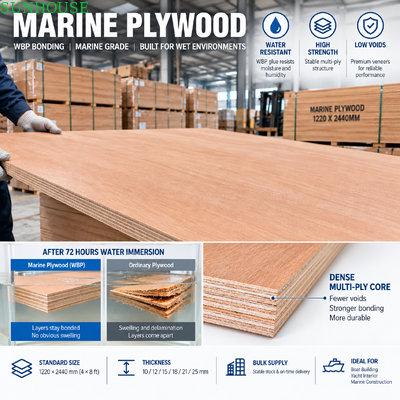
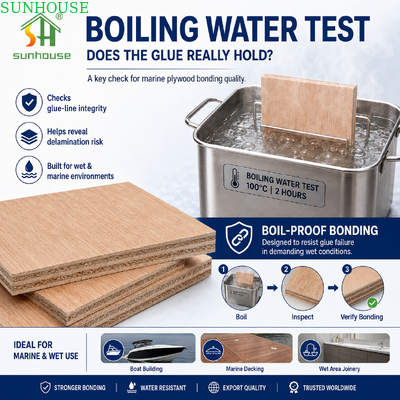
Plywood for kitchens, bathrooms and furniture should be selected according to the actual moisture exposure. A cabinet carcass may face high humidity and occasional splashes, while a sink base or vanity may be exposed to leaks and standing water. These are different service conditions and should not share an unqualified “100% waterproof” claim.
Choose the bond classification, face grade, thickness and surface finish to match the furniture design. Protect exposed edges and cut-outs, and use installation details that prevent water from collecting around the panel.
Even a moisture-resistant panel can swell or deteriorate if water enters through unsealed edges, damaged coatings or leaking joints.
| Item | Recommended specification | Why it matters |
|---|---|---|
| Core type | Veneer core / declared species | Defines internal construction. |
| Thickness | Confirm from cabinet design and loading | Supports shelf, side and partition design. |
| Face grade | Furniture-grade appearance as agreed | Affects veneer finish and surface preparation. |
| Bond class | Suitable for the expected humidity and moisture exposure | Supports glue-line durability. |
| Formaldehyde compliance | Destination-market requirement, where applicable | Supports indoor product compliance. |
| Edge treatment | Edge band / sealant / coating system | Reduces moisture entry at exposed edges. |
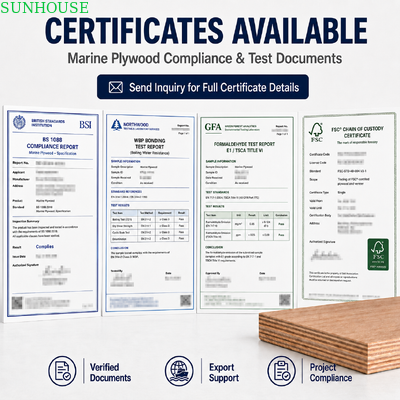
For products sold into the United States, the US EPA's TSCA Title VI programme regulates formaldehyde emissions from specified composite wood products, including covered hardwood plywood, MDF and particleboard. The exact product definition, applicable limit, certification and labeling obligations must be checked for the offered product and supply chain.
Do not use “TSCA Title VI compliant” or “CARB Phase 2” in a listing unless the product is within scope and the required third-party certification and records are available.
- Will the panel be used in a dry cabinet, humid room, sink base or another wet-risk location?
- What thickness and support spacing are required for the cabinet design?
- Which face grade and surface finish are required?
- How will edges, screw holes and plumbing cut-outs be sealed?
- Which formaldehyde-emission requirements apply in the destination market?
- Can the supplier provide batch-specific construction and test information?
Can waterproof plywood be used for bathroom cabinets?
Is plywood better than MDF for wet areas?
Does waterproof plywood meet TSCA Title VI automatically?
These public sources support the general technical explanations on this page. They do not certify the specific product offered by any supplier. Product-specific claims must be supported by the relevant factory records, test reports and destination-market documents.
- US EPA – Formaldehyde emission standards for composite wood products
- APA – Plywood and bond classifications
- USDA Forest Service – Moisture content and dimensional changes
- ISO 12465:2007 – Plywood: Specifications
Before publishing, insert verified product parameters, company identity, named technical reviewer, current factory photos and applicable test/certification documents. Remove any claim that cannot be substantiated for the exact product and batch.
Need a plywood specification matched to your project?
Share the required thickness, panel size, core construction, exposure condition and destination market for a product-specific quotation.
